BALLET REVIEW: MIXED PROGRAM
THE MAN IN BLACK; NO. 24; PUR TI MURO;
THEME AND VARIATIONS
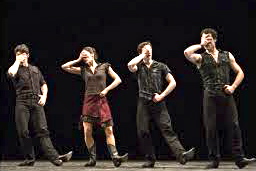
Pictured:
Robert Stephen, Rebekah Rimsay, James Leja, Piotr Stanczyk
JOHN COULBOURN, Special to TorSun
21 JUNE 2013
R: 4/5
TORONTO - Not many ballet dancers would trade toe shoes for cowboy boots, even to dance a ballet set to the music of the country master. But then, not many dancers have worked with a choreographer like James Kudelka, who has a proven gift for weaving music from any number of sources so organically into his balletic vision that he creates magic carpets to carry his audience to places we never realized we wanted to go. That’s what he’s accomplished in his elegantly heartfelt THE MAN IN BLACK, a work he created more than three years ago that is only now entering the repertoire of the National Ballet of Canada, where Kudelka once served as artistic director and resident choreographer.
TMIB had its company première Wednesday in an evening of mixed programming at the Four Seasons, teamed with a beautiful new duet choreographed by principal dancer Guillaume Côté, titled No. 24 and with Jorma Elo’s whimsical PUR TI MIRO and George Balanchine’s mint confection, THEME AND VARIATIONS, set to Tchaikovsky.
As its title implies, TMIB is set to the music of the legendary Johnny Cash — specifically, a handful of tunes recorded near the end of the singer’s life, when his voice seems all but rubbed raw from the savouring of the very richness of a life he’s preparing to leave. From six of Cash’s recordings — In My Life, Four Strong Winds, Sam Hall, If You Could Read My Mind, Hurt and the deeply touching Further On (Up the Road) — Kudelka creates a work for four dancers that celebrates the music, even while it is woven into a heart-wrenching study of love and loss that is deeply affecting but never maudlin.
His dancers — Rebekah Rimsay, Piotr Stanczyk, James Leja and Robert Stephen — are arrayed in full urban cowboy rig-out and, at least, initially, move with a swagger suggesting another night of two-steppin’ line dancing, but slowly, subtly, Kudelka weaves in just enough classical form to carry us to another plane as his talented quartet weaves its magic across a bare stage, lit with elegant simplicity by Trad A Burns. There is passion here, and deep sorrow, but there is also a sense of exultant celebration that is likely to leave you breathless, even while you wipe tears from your eyes.
For an audience already charmed by PUR TI MIRO’s heady blend of skill and archness and by the fluidity with which Elena Lobsanova washes up against the pure steel of Keiichi Hirano’s performance in No. 24, THE MAN IN BLACK could have been a perfect conclusion to a wonderful evening of dance. Which meant a further challenge to Greta Hodgkinson and Côte as they led us and their their castmates out of Kudelka’s living, breathing, bleeding world into the icy geometry of Balanchine at his best — and they succeeded impressively.
But it was still Cash, not Tchaikovsky, who played us home.
Friday, June 21, 2013
Monday, June 17, 2013
THEATRE REVIEW: THE DAISY THEATRE
JOHN COULBOURN, Special to TorSun
16 JUNE 2013
R: 4/5
TORONTO - Critics — sometimes, there’s just no pleasing us. Let’s take the case of Ronnie Burkett, for example.
For the better part of 40 years, this particular critic has been watching the incredibly gifted performer and his coterie of puppets and marionettes run delightfully amok in everything from kids’ puppet shows to sophisticated, thoughtful fare like Tinka’s New Dress and Street of Blood. And always in the back of my mind, I’ve harboured a concern (perhaps too often expressed) that, in his efforts to take what has long been a ghetto for children’s entertainment into an arena rich with possibility for adult audiences as well, he would lose control and go too far over the edge of good taste even for an adult audience.
Then, Friday night, seated in the Berkeley Street Theatre, watching Luminato’s world première of the Ronnie Burkett Theatre of Marionettes’ new production of THE DAISY THEATRE, I found myself wishing he’d loosen up a bit and take things just a little further.
To explain: THE DAISY THEATRE is Burkett’s homage to the Czech puppeteers who rather famously used their art as a means of resistance during the Nazi’s Second World War occupation of their country, and though the format is similar to today’s late-night talk shows, it is also something more — or it should aim to be.
Like a lot of late night fare, it features a skit or two — contemporary playwrights like Anusree Roy, Brad Fraser, Daniel MacIvor, Damien Atkins and others have authored skits Burkett and his marionettes will perform over the course of the run — plus a bit of singing and even a musical guest in the form of John Alcorn, who gets a credit for sound design too. It also features a bit of contemporary patter — references to the ongoing Ford pile-up and to a few other political sacred cows, many delivered by members of Burkett’s own stable of stars like Edna Rural, who drops by to talk about her new life in Toronto. There’s also a fair bit of audience participation, deftly handled and thoroughly enjoyable. In other words, it is typical Burkett fare, served up with the kind of irreverence and professional polish we’ve come to expect from this ‘kid’ from Medicine Hat. But, in the end, it all seems perhaps just a little too polished, overlaid with a sense of well-rehearsed improvisation, if you will.
For all its charm, what THE DAISY THEATRE needs — and what it will no doubt acquire over the length of its run — is the feeling that no one (including the master puppeteer himself) knows what is going to happen next; the feeling that the lunatics which Burkett has crafted with so much love and attention to detail over the years are not only capable of seizing their strings and taking this show into uncharted territory — but that they are about to do it. Truly, these are words I never dreamed I would ever use, but maybe it’s time to loosen up a bit, Ronnie.
JOHN COULBOURN, Special to TorSun
16 JUNE 2013
R: 4/5
TORONTO - Critics — sometimes, there’s just no pleasing us. Let’s take the case of Ronnie Burkett, for example.
For the better part of 40 years, this particular critic has been watching the incredibly gifted performer and his coterie of puppets and marionettes run delightfully amok in everything from kids’ puppet shows to sophisticated, thoughtful fare like Tinka’s New Dress and Street of Blood. And always in the back of my mind, I’ve harboured a concern (perhaps too often expressed) that, in his efforts to take what has long been a ghetto for children’s entertainment into an arena rich with possibility for adult audiences as well, he would lose control and go too far over the edge of good taste even for an adult audience.
Then, Friday night, seated in the Berkeley Street Theatre, watching Luminato’s world première of the Ronnie Burkett Theatre of Marionettes’ new production of THE DAISY THEATRE, I found myself wishing he’d loosen up a bit and take things just a little further.
To explain: THE DAISY THEATRE is Burkett’s homage to the Czech puppeteers who rather famously used their art as a means of resistance during the Nazi’s Second World War occupation of their country, and though the format is similar to today’s late-night talk shows, it is also something more — or it should aim to be.
Like a lot of late night fare, it features a skit or two — contemporary playwrights like Anusree Roy, Brad Fraser, Daniel MacIvor, Damien Atkins and others have authored skits Burkett and his marionettes will perform over the course of the run — plus a bit of singing and even a musical guest in the form of John Alcorn, who gets a credit for sound design too. It also features a bit of contemporary patter — references to the ongoing Ford pile-up and to a few other political sacred cows, many delivered by members of Burkett’s own stable of stars like Edna Rural, who drops by to talk about her new life in Toronto. There’s also a fair bit of audience participation, deftly handled and thoroughly enjoyable. In other words, it is typical Burkett fare, served up with the kind of irreverence and professional polish we’ve come to expect from this ‘kid’ from Medicine Hat. But, in the end, it all seems perhaps just a little too polished, overlaid with a sense of well-rehearsed improvisation, if you will.
For all its charm, what THE DAISY THEATRE needs — and what it will no doubt acquire over the length of its run — is the feeling that no one (including the master puppeteer himself) knows what is going to happen next; the feeling that the lunatics which Burkett has crafted with so much love and attention to detail over the years are not only capable of seizing their strings and taking this show into uncharted territory — but that they are about to do it. Truly, these are words I never dreamed I would ever use, but maybe it’s time to loosen up a bit, Ronnie.
Friday, June 14, 2013
MUSICAL THEATRE REVIEW: CATS
Pictured: Ma-Anne Dionisio
JOHN COULBOURN
Special to TorSun
13 JUNE 2013
R: 3.5/5
TORONTO - When it launched Toronto’s love affair with mega-musicals 28 years ago, it was all about the production — fitting, considering the broad expanse of the stage in the all-but derelict Elgin Theatre. Now, CATS has come back in a more intimate staging which opened Tuesday at the Panasonic, and this time out, the production takes a back seat to the players — good news for anyone who loves all the elements of musical theatre.
There are a few familiar faces — Marlene Smith returns as part of the producing team and Susan Cuthbert rejoins the ensemble — this intimate new take allows us to become invested in the individual players, revealing an admittedly sketchy storyline that, three decades ago, kept getting tangled up in Trevor Nunn’s staging. And while CATS has certainly used up more than its allotted nine lives on Toronto stages since it first opened, it now boasts an all-Canadian cast, demonstrating the depth of talent unleashed by that first long-ago production.
Principal amongst that talent, strutting its stuff under the direction of Dave Campbell, are performers like Ma-Anne Dionisio (who launched Toronto’s Miss Saigon before moving on to Maria in a Stratford’s West Side Story) as Grizabella, giving us a saccharine take on Memory, and Charles Azulay (familiar through Toronto productions of Rent, Les Miz and Ain’t Misbehavin’) elevated to the venerable role of Old Deuteronomy.
And while it is delightful (not to mention impressive) to see Cuthbert high-stepping still, what really delights throughout is the energy and commitment the entire cast brings. Michael Donald and Neesa Kenemy (as Mungojerrie and Rumpleteazer), Cory O’Brien (teaming up with Cuthbert in Gus, the Theatre Cat), and Martin Samuel (part Jagger, part Liberace as Rum Tum Tugger), and Devon Tullock (electric as Mr. Mistoffelees) - this 20-plus member company is rich in talent and enthusiasm.
And while there are moments when Gino Berti’s choreographic recreation of Gillian Lynne’s Broadway steps feels like an attempt to answer that age old question of how many angels can dance on the head of a pin, the enforced intimacy of the production somehow brings the charm of T.S. Eliot’s Old Possum’s Book Of Practical Cats more to the fore, making it more in tune, if you will, with Andrew Lloyd Webber’s ear-worm prone music.
Technically, however, it is all — you should pardon the expression — a bit of a dog’s breakfast, with costumes that already look a little road-weary and a set that forces perspective ’til its eyes cross. As for the almost religious elevation that used to end the show, it’s been replaced by a holographic projection that makes it look for all the world like they’ve drowned dear old Grizabella, stifling one last rendition of Memory with a burble. Still, if you’re one of those people who like shows where performance gets equal billing with technology, then this show is worth a look. It’s not your parents’ CATS — and, frankly, that’s the point.
Pictured: Ma-Anne Dionisio
JOHN COULBOURN
Special to TorSun
13 JUNE 2013
R: 3.5/5
TORONTO - When it launched Toronto’s love affair with mega-musicals 28 years ago, it was all about the production — fitting, considering the broad expanse of the stage in the all-but derelict Elgin Theatre. Now, CATS has come back in a more intimate staging which opened Tuesday at the Panasonic, and this time out, the production takes a back seat to the players — good news for anyone who loves all the elements of musical theatre.
There are a few familiar faces — Marlene Smith returns as part of the producing team and Susan Cuthbert rejoins the ensemble — this intimate new take allows us to become invested in the individual players, revealing an admittedly sketchy storyline that, three decades ago, kept getting tangled up in Trevor Nunn’s staging. And while CATS has certainly used up more than its allotted nine lives on Toronto stages since it first opened, it now boasts an all-Canadian cast, demonstrating the depth of talent unleashed by that first long-ago production.
Principal amongst that talent, strutting its stuff under the direction of Dave Campbell, are performers like Ma-Anne Dionisio (who launched Toronto’s Miss Saigon before moving on to Maria in a Stratford’s West Side Story) as Grizabella, giving us a saccharine take on Memory, and Charles Azulay (familiar through Toronto productions of Rent, Les Miz and Ain’t Misbehavin’) elevated to the venerable role of Old Deuteronomy.
And while it is delightful (not to mention impressive) to see Cuthbert high-stepping still, what really delights throughout is the energy and commitment the entire cast brings. Michael Donald and Neesa Kenemy (as Mungojerrie and Rumpleteazer), Cory O’Brien (teaming up with Cuthbert in Gus, the Theatre Cat), and Martin Samuel (part Jagger, part Liberace as Rum Tum Tugger), and Devon Tullock (electric as Mr. Mistoffelees) - this 20-plus member company is rich in talent and enthusiasm.
And while there are moments when Gino Berti’s choreographic recreation of Gillian Lynne’s Broadway steps feels like an attempt to answer that age old question of how many angels can dance on the head of a pin, the enforced intimacy of the production somehow brings the charm of T.S. Eliot’s Old Possum’s Book Of Practical Cats more to the fore, making it more in tune, if you will, with Andrew Lloyd Webber’s ear-worm prone music.
Technically, however, it is all — you should pardon the expression — a bit of a dog’s breakfast, with costumes that already look a little road-weary and a set that forces perspective ’til its eyes cross. As for the almost religious elevation that used to end the show, it’s been replaced by a holographic projection that makes it look for all the world like they’ve drowned dear old Grizabella, stifling one last rendition of Memory with a burble. Still, if you’re one of those people who like shows where performance gets equal billing with technology, then this show is worth a look. It’s not your parents’ CATS — and, frankly, that’s the point.
Tuesday, June 11, 2013
THEATRE REVIEW: TRIFLES

Pictured: Benedict Campbell
JOHN COULBOURN, Special to TorSun
10 JUNE 2013
R: 3/5
NIAGARA-ON-THE-LAKE — There are, no doubt, any number of reasons to pair the two one-act plays that represent the Shaw Festival’s lunchtime offering this season, not the least of which is the fact that each was authored by a playwright instrumental in the glory days of the seminal Provincetown Theatre. The first, titled TRIFLES — which fittingly shares its name with the double-bill that opened last weekend at the Court House — is authored by Susan Glaspell, an early feminist playwright who authored 11 plays for Provincetown, and the second, A WIFE FOR A LIFE, is an early work from Eugene O’Neill, who churned out 14 plays for the theatre.
Surprisingly, TRIFLES is the better play, despite the fact the O’Neill is today the better known playwright. It’s sort of a prairie gothic murder mystery — imagine Gwen Pharis Ringwood’s Still Stands the House, once studied in Canadian high school, given an obvious feminist twist — that involves a murder investigation by a patronizing county attorney (Jeff Irving) and his assistant (Graeme Somerville), thwarted by the sheriff’s naive wife (Kaylee Harwood) and a canny neighbour woman (Julain Molnar).
There’s interesting work here from all, but the two most impressive performances director Meg Roe draws from her ensemble come from the angular Molnar, creating a character full of grit, and Benedict Campbell, all but disappearing into a small but pivotal role.
Campbell falls back on his celebrated vocal technique in his casting as the veteran prospector in A WIFE FOR A LIFE, however, playing opposite Irving, cast as a younger, more romantic gold-chaser who has, with Campbell, struck it rich. Somerville has a fine cameo as a ne’er-do-well neighbour, burned out by gold fever. But in the final analysis, it bears remembering that this is a play O’Neill attempted to destroy — and with good reason, for it is everything his later plays never were: utterly predictable, unbelievably trite and laughably melodramatic.
Both dramas are set on the same ramshackle set, drawn more, one suspects, from designer Camellia Koo’s fevered imagination than anything ever inhabited by hardscrabble farmers or prospectors. The former would have surely frozen to death here and the latter would have been forced to give up, either after burning their hands to stumps on hot stove lifters, or being laughed out of town for panning gold in the sink of their miner’s shack.
To bridge the two worlds, director Roe enlists the aid of sound designer Alessandro Juliani who, despite fires that roar but don’t crackle, gives us some lovely choral work from the cast — work that underlines the fact that while there may be any number of reasons to harness two old work-horses like these to the same plow, the very fact one of the playwrights wanted the work in question destroyed should have mitigated against attempting to break new ground with such a dull blade.

Pictured: Benedict Campbell
JOHN COULBOURN, Special to TorSun
10 JUNE 2013
R: 3/5
NIAGARA-ON-THE-LAKE — There are, no doubt, any number of reasons to pair the two one-act plays that represent the Shaw Festival’s lunchtime offering this season, not the least of which is the fact that each was authored by a playwright instrumental in the glory days of the seminal Provincetown Theatre. The first, titled TRIFLES — which fittingly shares its name with the double-bill that opened last weekend at the Court House — is authored by Susan Glaspell, an early feminist playwright who authored 11 plays for Provincetown, and the second, A WIFE FOR A LIFE, is an early work from Eugene O’Neill, who churned out 14 plays for the theatre.
Surprisingly, TRIFLES is the better play, despite the fact the O’Neill is today the better known playwright. It’s sort of a prairie gothic murder mystery — imagine Gwen Pharis Ringwood’s Still Stands the House, once studied in Canadian high school, given an obvious feminist twist — that involves a murder investigation by a patronizing county attorney (Jeff Irving) and his assistant (Graeme Somerville), thwarted by the sheriff’s naive wife (Kaylee Harwood) and a canny neighbour woman (Julain Molnar).
There’s interesting work here from all, but the two most impressive performances director Meg Roe draws from her ensemble come from the angular Molnar, creating a character full of grit, and Benedict Campbell, all but disappearing into a small but pivotal role.
Campbell falls back on his celebrated vocal technique in his casting as the veteran prospector in A WIFE FOR A LIFE, however, playing opposite Irving, cast as a younger, more romantic gold-chaser who has, with Campbell, struck it rich. Somerville has a fine cameo as a ne’er-do-well neighbour, burned out by gold fever. But in the final analysis, it bears remembering that this is a play O’Neill attempted to destroy — and with good reason, for it is everything his later plays never were: utterly predictable, unbelievably trite and laughably melodramatic.
Both dramas are set on the same ramshackle set, drawn more, one suspects, from designer Camellia Koo’s fevered imagination than anything ever inhabited by hardscrabble farmers or prospectors. The former would have surely frozen to death here and the latter would have been forced to give up, either after burning their hands to stumps on hot stove lifters, or being laughed out of town for panning gold in the sink of their miner’s shack.
To bridge the two worlds, director Roe enlists the aid of sound designer Alessandro Juliani who, despite fires that roar but don’t crackle, gives us some lovely choral work from the cast — work that underlines the fact that while there may be any number of reasons to harness two old work-horses like these to the same plow, the very fact one of the playwrights wanted the work in question destroyed should have mitigated against attempting to break new ground with such a dull blade.
THEATRE REVIEW: LADY WINDERMERE'S FAN

Pictured: Martin Happer, Tara Rosling
JOHN COULBOURN, Special to TorSun
10 JUNE 2013
R: 5/5
NIAGARA-ON-THE-LAKE — Director Peter Hinton and his design team tackle the Shaw Festival’s production Oscar Wilde’s comedy, LADY WINDERMERE'S FAN: A PLAY ABOUT A GOOD WOMAN, with such spit, polish and enthusiasm they earn the trust they need to pull it off in style.
Indeed, as Hinton’s shifting tableau of Victorian women flirting with fans gives way to the opening scene on the Festival Theatre stage, glimpsed through the aperture curtain developed by Hal Prince in Kiss Of the Spider Woman, this is a feast — flawlessly crafted characters, beautifully costumed by William Schmuck, each living an illusion of a wonderful life while speaking wonderful witty lines, brought together to underscore Wilde’s indulgent affection for the foibles of the human race as represented by Victorian society.
Marla McLean is the Lady of title, although whether she is the ‘Good Woman’ is open to debate. Married to the wealthy Lord Windermere (a letter-perfect Martin Happer), with whom she has a six-month old child, she is celebrating her 21st birthday as the show begins, playing with the fan her husband has given her and playing at being a grande dame too. But, while she is entertaining a fan of another sort — Gray Powell’s edgy, seductive Lord Darlington — the Duchess of Berwick (Corrine Koslo, auditioning for Lady Bracknell in subsequent productions of Wilde’s Earnest) drops by with news that Lord Windermere has not only been keeping company with the mysterious Mrs. Erlynne (Tara Rosling) but perhaps has been supplying the continental lady of mystery with money, too. Reeling from these revelations, Lady Windermere is driven to despair when her husband demands Mrs. Erlynne be invited to the birthday celebration planned for the evening.
Featuring an elaborate, melodramatic plot almost impossible to discuss without spoiling the fun, this is a Wilde play that offers a stable of wild characters that Hinton serves up with relish — dissolutes like Patrick McManus’s Mr. Dumby, faded beauties like Sharry Flett’s Lady Plymdale, timid ingenues like Kate Besworth’s Lady Carlisle and delightful dolts like Jim Mezon’s Lord Lorton, even the by-now-obligatory Wilde stand-in (a page-bouyed Kyle Blair as Cecil Graham, dropping bon mottes like fairy dust). They inhabit a series of sets pieces, wistfully inspired by great artists of the period — Whistler, Gaugin, Boldini and Cassatt , all evoked in breathtaking fashion by designers Teresa Przybylski (sets) and Louise Guinand (lighting) — before blossoming into a complete own world as the story closes.
Hinton’s inspiration is not purely historical either, and while he marks everything with a theatrical Victorian reserve that borders on the stilted, he livens things up with contemporary musical references ranging from Rufus Wainwright to Katy Perry with a few classical stops in between. In what amounts to a flawless production, Hinton’s only misstep is his failure to trust his audience (or perhaps his playwright) sufficiently and his series of often fuzzy projected Wildean epigrams adds up to little more (and a lot less) than gilding on a lily that is already golden.

Pictured: Martin Happer, Tara Rosling
JOHN COULBOURN, Special to TorSun
10 JUNE 2013
R: 5/5
NIAGARA-ON-THE-LAKE — Director Peter Hinton and his design team tackle the Shaw Festival’s production Oscar Wilde’s comedy, LADY WINDERMERE'S FAN: A PLAY ABOUT A GOOD WOMAN, with such spit, polish and enthusiasm they earn the trust they need to pull it off in style.
Indeed, as Hinton’s shifting tableau of Victorian women flirting with fans gives way to the opening scene on the Festival Theatre stage, glimpsed through the aperture curtain developed by Hal Prince in Kiss Of the Spider Woman, this is a feast — flawlessly crafted characters, beautifully costumed by William Schmuck, each living an illusion of a wonderful life while speaking wonderful witty lines, brought together to underscore Wilde’s indulgent affection for the foibles of the human race as represented by Victorian society.
Marla McLean is the Lady of title, although whether she is the ‘Good Woman’ is open to debate. Married to the wealthy Lord Windermere (a letter-perfect Martin Happer), with whom she has a six-month old child, she is celebrating her 21st birthday as the show begins, playing with the fan her husband has given her and playing at being a grande dame too. But, while she is entertaining a fan of another sort — Gray Powell’s edgy, seductive Lord Darlington — the Duchess of Berwick (Corrine Koslo, auditioning for Lady Bracknell in subsequent productions of Wilde’s Earnest) drops by with news that Lord Windermere has not only been keeping company with the mysterious Mrs. Erlynne (Tara Rosling) but perhaps has been supplying the continental lady of mystery with money, too. Reeling from these revelations, Lady Windermere is driven to despair when her husband demands Mrs. Erlynne be invited to the birthday celebration planned for the evening.
Featuring an elaborate, melodramatic plot almost impossible to discuss without spoiling the fun, this is a Wilde play that offers a stable of wild characters that Hinton serves up with relish — dissolutes like Patrick McManus’s Mr. Dumby, faded beauties like Sharry Flett’s Lady Plymdale, timid ingenues like Kate Besworth’s Lady Carlisle and delightful dolts like Jim Mezon’s Lord Lorton, even the by-now-obligatory Wilde stand-in (a page-bouyed Kyle Blair as Cecil Graham, dropping bon mottes like fairy dust). They inhabit a series of sets pieces, wistfully inspired by great artists of the period — Whistler, Gaugin, Boldini and Cassatt , all evoked in breathtaking fashion by designers Teresa Przybylski (sets) and Louise Guinand (lighting) — before blossoming into a complete own world as the story closes.
Hinton’s inspiration is not purely historical either, and while he marks everything with a theatrical Victorian reserve that borders on the stilted, he livens things up with contemporary musical references ranging from Rufus Wainwright to Katy Perry with a few classical stops in between. In what amounts to a flawless production, Hinton’s only misstep is his failure to trust his audience (or perhaps his playwright) sufficiently and his series of often fuzzy projected Wildean epigrams adds up to little more (and a lot less) than gilding on a lily that is already golden.
Monday, June 10, 2013
THEATRE REVIEW: PEACE IN OUR TIME

Pictured: Neil Barclay
JOHN COULBOURN, Special to TorSun
09 JUNE 2013
R: 2.5/5
NIAGARA-ON-THE-LAKE — Some masterpieces exist for all time, some simply for their time — and while Bernard Shaw’s GENEVA is something far less than a masterpiece, it is, nonetheless, a work for its time. Set in the city of title, GENEVA is Shaw’s ill-fated attempt to awaken the world (and the now defunct League of Nations) before it was plunged into global conflict in the Second World War.
When GENEVA premiered in Warsaw in 1938, Czechoslovakia had fallen to Hitler and Poland was in his sights — and it was daring indeed to mount a play which saw ill-disguised send-ups of the Führer of the Third Reich and his nasty friends called to task, even fictitiously, for their growing list of outrages.
Problem was, no one had any idea of the extent of those outrages. Within mere months of GENEVA’s première, Hitler and the gang established that what they were up to was no laughing matter and GENEVA was deservedly branded a problem play and consigned to the dustbin. Even an attempt to revive it here at the Shaw Festival, where the Shavian flame burns brightest, proved less than successful in 1988. But today, with Jackie Maxwell at the helm, some of Shaw’s more problematic works are getting a second chance, as modern-day playwrights ‘collaborate posthumously’ with the late and now cooperative playwright in an attempt to make some of his plays more palatable to modern audiences. Under Maxwell’s auspices, playwright John Murrell has re-worked GENEVA, rechristened it PEACE IN OUR TIME: A COMEDY and offered it up on the stage of the Court House Theatre, where it opened Friday under the brisk direction of Blair Williams, working with a cast that is nothing if not enthusiastic.
Murrell maintains the Shavian conceit that sets the action in the court of the League of Nations, headquartered in Geneva, where a group of the world’s unhappy dispossessed — a Spanish widow (Claire Jullien), a German Jew (Charlie Gallant), an Anglican Bishop (Michael Ball), a British diplomat (Patrick Galligan) and a Soviet Commissar (Moya O’Connell) are joined by an American ingenue (Diana Donnelly) and a disgruntled Canadian conservative (Andrew Bunker) in an attempt to force Il Duce (Neil Barclay), Der Führer (Ric Reid) and El Generalisimo (Lorne Kennedy) to answer for the outrages they have committed. Jeff Meadows, Kevin McGarry and Sanjay Talwar round out the cast.
Problem is, those outrages were far more than even Shaw could appreciate. When GENEVA was written, it thumbed its nose at men who threatened world peace and made them look like fools. Today, regardless of how it is rewritten, it thumbs its nose at men who did more than threaten the world — men who plunged the world into a global conflict and unleashed a genocide all but unparalleled in the civilized world.
And any attempt to make these monsters look like mere fools, diminishes not only their evil but the courage it took to topple them as well. This is one dog that should have been left to doze.

Pictured: Neil Barclay
JOHN COULBOURN, Special to TorSun
09 JUNE 2013
R: 2.5/5
NIAGARA-ON-THE-LAKE — Some masterpieces exist for all time, some simply for their time — and while Bernard Shaw’s GENEVA is something far less than a masterpiece, it is, nonetheless, a work for its time. Set in the city of title, GENEVA is Shaw’s ill-fated attempt to awaken the world (and the now defunct League of Nations) before it was plunged into global conflict in the Second World War.
When GENEVA premiered in Warsaw in 1938, Czechoslovakia had fallen to Hitler and Poland was in his sights — and it was daring indeed to mount a play which saw ill-disguised send-ups of the Führer of the Third Reich and his nasty friends called to task, even fictitiously, for their growing list of outrages.
Problem was, no one had any idea of the extent of those outrages. Within mere months of GENEVA’s première, Hitler and the gang established that what they were up to was no laughing matter and GENEVA was deservedly branded a problem play and consigned to the dustbin. Even an attempt to revive it here at the Shaw Festival, where the Shavian flame burns brightest, proved less than successful in 1988. But today, with Jackie Maxwell at the helm, some of Shaw’s more problematic works are getting a second chance, as modern-day playwrights ‘collaborate posthumously’ with the late and now cooperative playwright in an attempt to make some of his plays more palatable to modern audiences. Under Maxwell’s auspices, playwright John Murrell has re-worked GENEVA, rechristened it PEACE IN OUR TIME: A COMEDY and offered it up on the stage of the Court House Theatre, where it opened Friday under the brisk direction of Blair Williams, working with a cast that is nothing if not enthusiastic.
Murrell maintains the Shavian conceit that sets the action in the court of the League of Nations, headquartered in Geneva, where a group of the world’s unhappy dispossessed — a Spanish widow (Claire Jullien), a German Jew (Charlie Gallant), an Anglican Bishop (Michael Ball), a British diplomat (Patrick Galligan) and a Soviet Commissar (Moya O’Connell) are joined by an American ingenue (Diana Donnelly) and a disgruntled Canadian conservative (Andrew Bunker) in an attempt to force Il Duce (Neil Barclay), Der Führer (Ric Reid) and El Generalisimo (Lorne Kennedy) to answer for the outrages they have committed. Jeff Meadows, Kevin McGarry and Sanjay Talwar round out the cast.
Problem is, those outrages were far more than even Shaw could appreciate. When GENEVA was written, it thumbed its nose at men who threatened world peace and made them look like fools. Today, regardless of how it is rewritten, it thumbs its nose at men who did more than threaten the world — men who plunged the world into a global conflict and unleashed a genocide all but unparalleled in the civilized world.
And any attempt to make these monsters look like mere fools, diminishes not only their evil but the courage it took to topple them as well. This is one dog that should have been left to doze.
BALLET REVIEW: CARMEN

Pictured: Greta Hodgkinson
JOHN COULBOURN, Special to TorSun
09 JUNE 2013
R: 3/5
Perhaps no literary heroine has benefited more from the unfolding feminist movement than the one who gave her name to Prosper Mérimée's novella, CARMEN. Born as the quintessential temptress whose beauty drives poor innocent men to their doom, the sexually voracious cigar girl has been transformed, as much by changing mores as by the opera of the same name composed by Georges Bizet or the countless ballets she has spawned, into the prototype of the liberated woman.
The latest retelling of her story opened at the Four Seasons Centre this week, with the National Ballet of Canada revisiting choreographer Davide Bombana's modernist take on the tale, following up their presentation in 2009, of his 2006 one-act adaptation, with his two act take, set to an exhilarating score that blends Bizet's iconic compositions with a slew of contemporary references.
As story ballets go, the end product here, frankly owes far more to Bombana's interpretation of Mérimée's tale than it does to Mérimée, as the choreographer strips away everything from the original, and from Bizet's opera, that doesn't serve his vision of a freedom-loving young beauty (superbly danced at Thursday evening's performance by the seemingly perennial Greta Hodgkinson), and her ill-fated mutual attraction to the policeman Don José. In the latter role, Piotr Stanczyk underscores yet again just how thrilling it can be when ballet breaks with its long tradition of sending a boy to do a man's job and sends a man instead.
In 11 scenes, showcasing choreography so demanding one suspects Bombana has aspirations to choreograph for Cirque du Soleil, a new — if not terribly satisfying — version of the tale of Don José and Carmen comes to life, transforming the character of Michaela (a flawless Stephanie Hutchison) from Mérimée's personification of feminine innocence to something far more pedestrian in the process. It also draws thrilling performances from Keiichi Hirano (as the bandit leader Garcia) and Rebekah Rimsay (as an aged version of the temptress of title) along the way.
And while it's hard to warm up to Dorin Gal's scenic design, intended, one suspects, to evoke a bullring in a country that doesn't know from hockey rinks, it still makes for often compelling viewing, carried along more on the combined strength of the demanding choreography and its exuberant execution, than by Bombana's rather pedestrian hormone-drenched adaptation. But not even the skills of Jiří Jelinek prove sufficient to carry the penultimate scene that sees Jelinek as the matador Escamillo transformed into a bull who ruts with Carmen while four 'toreadors' in comedic butch drag sing and do a mash-up version of the fandango in the background.
So, in the end, if its fine dancing and exacting choreography that sets your heart to soaring in the waning days of spring, this CARMEN may be just the ticket. But if you're looking for a CARMEN for the ages — or even just a memorable facsimile of same — then you might want to take a pass and wait, with fingers crossed, 'til the opera comes around again.

Pictured: Greta Hodgkinson
JOHN COULBOURN, Special to TorSun
09 JUNE 2013
R: 3/5
Perhaps no literary heroine has benefited more from the unfolding feminist movement than the one who gave her name to Prosper Mérimée's novella, CARMEN. Born as the quintessential temptress whose beauty drives poor innocent men to their doom, the sexually voracious cigar girl has been transformed, as much by changing mores as by the opera of the same name composed by Georges Bizet or the countless ballets she has spawned, into the prototype of the liberated woman.
The latest retelling of her story opened at the Four Seasons Centre this week, with the National Ballet of Canada revisiting choreographer Davide Bombana's modernist take on the tale, following up their presentation in 2009, of his 2006 one-act adaptation, with his two act take, set to an exhilarating score that blends Bizet's iconic compositions with a slew of contemporary references.
As story ballets go, the end product here, frankly owes far more to Bombana's interpretation of Mérimée's tale than it does to Mérimée, as the choreographer strips away everything from the original, and from Bizet's opera, that doesn't serve his vision of a freedom-loving young beauty (superbly danced at Thursday evening's performance by the seemingly perennial Greta Hodgkinson), and her ill-fated mutual attraction to the policeman Don José. In the latter role, Piotr Stanczyk underscores yet again just how thrilling it can be when ballet breaks with its long tradition of sending a boy to do a man's job and sends a man instead.
In 11 scenes, showcasing choreography so demanding one suspects Bombana has aspirations to choreograph for Cirque du Soleil, a new — if not terribly satisfying — version of the tale of Don José and Carmen comes to life, transforming the character of Michaela (a flawless Stephanie Hutchison) from Mérimée's personification of feminine innocence to something far more pedestrian in the process. It also draws thrilling performances from Keiichi Hirano (as the bandit leader Garcia) and Rebekah Rimsay (as an aged version of the temptress of title) along the way.
And while it's hard to warm up to Dorin Gal's scenic design, intended, one suspects, to evoke a bullring in a country that doesn't know from hockey rinks, it still makes for often compelling viewing, carried along more on the combined strength of the demanding choreography and its exuberant execution, than by Bombana's rather pedestrian hormone-drenched adaptation. But not even the skills of Jiří Jelinek prove sufficient to carry the penultimate scene that sees Jelinek as the matador Escamillo transformed into a bull who ruts with Carmen while four 'toreadors' in comedic butch drag sing and do a mash-up version of the fandango in the background.
So, in the end, if its fine dancing and exacting choreography that sets your heart to soaring in the waning days of spring, this CARMEN may be just the ticket. But if you're looking for a CARMEN for the ages — or even just a memorable facsimile of same — then you might want to take a pass and wait, with fingers crossed, 'til the opera comes around again.
Subscribe to:
Posts (Atom)