Thursday, September 29, 2011


MUSICAL THEATRE REVIEW:
CHESS
29 SEPT/11

JOHN COULBOURN,
QMI Agency
R: 3.5/5

TORONTO - For almost three decades, the musical CHESS has had the distinction of being one of the most popular musicals most North Americans had never seen. Composed by ABBA’s Benny Andersson and Bjorn Ulvaeus and featuring lyrics and book by Tim Rice, the work has never had a completely successful commercial production here in North America, despite the fact that it ran for three years in London’s West End, back in the ’80s.

Its recorded score, on the other hand, quickly became a treasured centrepiece in a lot of musical theatre libraries, spinning off a few hits like One Night in Bangkok, I Know Him So Well and Heaven Help My Heart. And that score remains the main reason to see the new, direct-from-Great-Britain production that’s taken up residence at the Princess of Wales through Oct. 30.

Not that director/choreographer Craig Revel Horwood is content to simply recycle that original score in its entirety. He’s reworked and reshaped it instead, adding and subtracting in an effort to fuse the sprawling and disparate elements of the tale into a compelling piece of theatre. And he does add a degree of focus to a complicated tale that stretches from Italy to Bangkok in a year-long exploration of a pair of intersecting love triangles set in the world of international chess competitions at the height of the Cold War. Although it’s still handy, even necessary, to have a four-page plot summary included in the program.

It is obvious Horwood still relies mainly on the music to sell this piece, taking a page from other modern musical productions and demanding that his cast do double duty, combining the heavy demands of singing, acting and dancing with orchestral duties, backed only by a drummer and a keyboardist off-stage. Not surprisingly, Horwood and his design team (sets and costumes by Christopher Woods, video by Jack James) take most of their visual cues from the title, transforming their overcrowded stage into a chess board inhabited by a chorus arrayed as the pieces in a very adult chess game.

Into that mix, he throws the story’s protagonists — the bad boy American, Freddie Trumper (played by James Fox), the pensive Russian Anotoly Sergievsky (Tam Mutu), Trumper’s much-abused second Florence Vassy (Shona White), and Sergievsky’s wife Svetlana (Rebecca Lock). With David Erik’s strutting, bemuscled Arbiter overseeing the activities, the four principal characters become pieces in a game of love and international intrigue that rivals the game of chess itself, with Florence forsaking Freddie for Anotoly, only to be thrown over for Svetlana.

Problem is, in Horwood’s fevered vision, everything is all but smothered by a deep layer of sexuality — an in-your-face sensuality taking the place of anything even remotely resembling real intimacy. As a result, when the much-abused Florence finally gets around to singing I Know Him So Well, one knows she’s speaking only in the biblical sense. Further, thanks to Horwood’s choreographic vision — think bawdy ballet — One Night in Bangkok looks pretty much like One Night in Merano, with less clothes.

And while there is some fine work scattered throughout the two-and-a-half-hour production— Fox’s Pity the Child is particularly touching, as is Mutu’s powerful Anthem — there is so much heart-on-the-sleeve belting that the music loses much of its emotional drive and virtually all of its subtlety. It’s still CHESS, of course, but in this game the pieces seem to have been carved more with an axe than with a craftsman’s tools.

DAILY DISH: Tomson Highway in cabaret
29 SEPT/11

JOHN COULBOURN,
QMI Agency


If you've been hungering for a Tomson Highway fix, turns out you won't have to wait until the revival of The Rez Sisters opens on the Factory Theatre mainstage in November.

Factory officials have announced that Highway, one of Canada's most important playwrights and novelists, has agreed to perform a special one-night cabaret in the Studio Theatre, working with Peruvian-Canadian vocalist Patricia Cano, performing a dozen songs from The (Post) Mistress, Highway's latest play.

The evening of cabaret, with proceeds benefiting the Factory Theatre, will take place Oct 27. Tickets, priced at $150 (with a tax receipt issued for the maximum allowable amount) are available at 416-504-9971 or online at factorytheatre.ca.

Tuesday, September 27, 2011


THEATRE REVIEW:
THE MAIDS

27 SEPT/11

JOHN COULBOURN,
QMI Agency
R: 4/5
Pictured: Ron Kennell,
Maria Ricossa

TORONTO - Obsessed as it is with sadomasochistic role playing, Jean Genet’s THE MAIDS will never be an easy play for an audience to watch. But in a new production that hit the stage of Buddies in Bad Times last week, director Brendan Healy manages to make it so riveting that one might not even notice how squirm-inducing it can be.


Long considered a masterwork from the bad boy of 20th century French literature, THE MAIDS was inspired by the celebrated 1933 murder of a French woman at the hands of her embittered personal maids, two young sisters who claimed they had killed their abusive employer in self-defense. 
As filtered through Genet’s perspective, however, those maids — Solange and Claire — are transformed into abusers themselves, locked in a sick little game where they take turns playing an abusive mistress and her long-suffering maid.
 And despite the fact that, in the playing, the mistress of their fantasies proves far more vile than the reality presented by their actual mistress, they have nonetheless become so lost in their fantastic world that tragedy has become almost inevitable.


While Genet might have played fast and loose with the facts, in this production, working with a translation by Martin Crimp, Healy adds even more wrinkles to Genet’s troubled characters, with some compelling if unorthodox casting. Even though Genet once famously asked that all the women in his plays be played by adolescent males, Healy’s decision to cast Ron Kennell in the role of Claire, the younger of the two maids, is unorthodox, but not so much because of the actor’s gender as his appearance.
 Kennell may not look the part, but as anyone who saw the hugely talented actor in his performance in the title role of Monsieur D’eon is a Woman will tell you, the otherwise masculine Kennell exhibits an uncanny ability to inhabit female characters, rather than merely playing them. And he can do it, even when he’s arrayed in the sort of butch drag designer Julie Fox has given him for everyday apparel in this production.


As Claire’s older sister Solange, Healy has cast Diane D’Aquila (even though she could probably only hope to be cast as Claire’s mother by a director with less imagination), and it works wonderfully well — particularly as Healy further muddies the waters by giving both maids haircuts that flirt with androgyny, suggesting, in the process, that maybe Solange has a secret or two tucked away as well.
In their fantasy scenes together, with Kennell playing mistress and D’Aquila, her long-suffering maid, the two of them are riveting, even though one slowly realizes that the full extent of their depravity is boundless.

That becomes evident with the appearance of Madame, their much reviled and abused mistress. While again, the ultra feminine Maria Ricossa might not be an obvious choice for a character often played as overbearing and demanding, she’s a potent choice. 
Under Healy’s direction she is spoiled, pampered and careless, but Ricossa’s Madame is also clearly almost of another species than her two maids — a gazelle to their mules, a glorious songbird to their mudhens. As such, she has inspired an envy that has morphed into hatred as the two of them have sunk ever deeper into their games and obsessions.


But make no mistake: Set against Fox’s pretty-in-Pepto-pink set, lit by Kimberly Purtell and strongly acted throughout. THE MAIDS is still not easy viewing, but in its deconstruction of human nature, this production is never anything less than utterly compelling.


Monday, September 26, 2011


THEATRE NEWS: Blake leaving Shaw Fest
26 SEPT/11

JOHN COULBOURN - QMI Agency

TORONTO - After 17 years at the administrative helm of the Shaw Festival, Colleen Blake has decided to move along.

Her decision to leave the position of executive director was announced yesterday by the Festival, although Blake will remain in the position until her successor is appointed, which is expected to happen sometime early in the spring of 2012. Calling it “an enormous privilege to share the leadership of this remarkable organization,” Ms. Blake paid tribute to the entire company in announcing her departure, saying the fest is “full of dedicated and talented people who give their all on a continual basis."

THEATRE REVIEW:
PRIVATE LIVES

26 SEPT/11

JOHN COULBOURN,
QMI Agency
R: 4.5/5
Pictured: Kim Kattrell,
Paul Gross


TORONTO - In their day, the plays of Noel Coward were considered by many to be the ne plus ultra of sophistication, affording as they did often amusing glimpses into a world where all that glittered was indeed gold and everything, from the diamonds to the champagne, sparkled with elegance. But what to make of works like Coward’s PRIVATE LIVES, considered by many to be his most exquisitely crafted comedy, in a world where the Kardashians are cast as arbiters of elegance and, on a Jersey Shore that seems to stretch from the Atlantic to the Pacific, all that glitters is the latest Trump development?

Well, if you’re acclaimed British director Richard Eyre, you throw a few things overboard — particularly in the brittle sophistication department, broadening the innuendo and sending up the elegance with just the faintest touch of slapstick — and then go full speed ahead. While there is no way of knowing what Coward might have made of Eyre’s Broadway-bound take on PRIVATE LIVES, which opened at the Royal Alexandra Theatre Sunday, one suspects he would have embraced Eyre’s talent to amuse and enthusiastically welcomed this as a PRIVATE LIVES for our time.

As it was in its acclaimed West End edition, Eyre’s production is built around the comedic talents of Kim Cattrall, still best known as the sexually liberated Samantha on Sex and the City, despite several attempts to broaden her horizon and deepen her reputation. Cattrall is cast as gay divorcee Amanda, who on the night of her second wedding, finds herself honeymooning next door to her ex-husband, Elyot, who is also similarly occupied with his second wife. From the get go, Cattrall makes it clear that being divorced might just be the least of Amanda’s transgressions as she straddles chairs and otherwise comports herself with a delightful air of sexual anachronism, underpinned by strong comedic chops.

As Elyot, Paul Gross abandons the red serge of Due South in favour of black cashmere tuxes and silk pajamas, and while he may not wear them with the louche air of one to the manner born, he still fills them out to maximum effect, all the while demonstrating a wicked talent for comedy that, while broader than Coward demands, still serves the work without diminishing it unduly.

As Amanda and Elyot’s newly acquired and hastily abandoned spouses, Sybil and Victor, Eyre has cast Anna Madeley and Simon Paisley-Day, and while the former could (and probably should) play her character as more of a pill, the latter is note perfect, to the point that he draws some of the show’s biggest laughs with some of its least funny lines. Caroline Lena Olsson rounds out the cast, making the most of the role of Amanda’s French maid.

Eyre and his collaborators — Rob Howell on set and costumes, David Howe on lighting — have even shaken things up from a design perspective. Where designers for PRIVATE LIVES have long vied to create sets and costumes seemingly ripped from the Architectural Digests and Vogues of the day, this production places far less importance on leaving their audience in awe. The first act, set in a seaside hotel in the northwest of France, takes place on adjoining terraces that are adequate if unremarkable, which is, come to think of it, a pretty fair description of the costuming in that act as well. And when the action moves to Amanda’s Paris flat for Acts 2 and 3, sets and costumes acquire an almost tongue-in-cheek element that contributes hugely to the fun for everyone, save a few hapless gold fish.

About the only thing that Eyre hasn’t changed is the way all the best productions of Coward have always treated his text, which becomes, in the act of carelessly tossing it off, pure comic gold.

PRIVATE LIVES runs through Oct. 30.

Sunday, September 25, 2011


THEATRE REVIEW:
IN THE NEXT ROOM

25 SEPT/11

JOHN COULBOURN,
QMI Agency
R: 2.5/5

TORONTO - Sometimes, a little bit of knowledge can be a dangerous thing — but often, it doesn’t even add up to that. For instance, playwright Sarah Ruhl stumbled upon the information that vibrators were in use in the otherwise up-tight Victorian era, and rather than turning that knowledge into the punchline of a monologue on the contradictions of that famous time, crocheted it instead into a full-length play, titled, perhaps not too surprisingly, IN THE NEXT ROOM, OR THE VIBRATOR PLAY.

And, based more on the fact that it has already been nominated for a Tony Award and a Pulitzer Prize than on what one sees on stage at the Tarragon Theatre (where IN THE NEXT ROOM opened last week in its Canadian première in a co-production with the Royal Manitoba Theatre Centre), her play is not half bad. But in the end, one expects something that isn’t half bad to be at least half good — and in this production, half good is, quite frankly, still a little beyond its reach.

Set in the upscale Victorian home of Dr. Givings (David Storch) and his wife Catherine (Trish Lindstrom), the play focuses not just on the marriage of the up-tight doctor and his nubile young wife, but on the clinic he runs in the next room — a clinic specializing in treating ‘hysteria’ through a certain mechanical intervention, only recently facilitated by the harnessing of electricity.

Already sexually frustrated and rendered insecure by her inability to nurse her new baby, Catherine is at first bewildered, then intrigued by the strange sounds that emanate from her husband’s office as he and his un-married assistant (Elizabeth Saunders) provide intimate intervention to relieve the ‘hysteric’ symptoms of patients like the fey Sabrina Daldry, played by Melody A. Johnson. And judging from their success with Mrs. Daldry, who recovers among other things her ability to play the piano, most women blossom under their care.

Not that women are the only patients the good doctor attracts. In fact, a troubled young man (Jonathan Watton) signs up for a course of treatment — men suffering from ‘hysteria’ are rare, the good doctor concedes, but this one is after all an artist. The presence of a free thinking, not to mention good looking, young man, throws the household into a tizzy that eventually involves the wet-nurse (Marci T. House), Mrs. Daldry’s husband (Ross McMillan) and something called the Chattanooga Vibrator, which soon restores the young artist to glowing health and well-being.

In writing the play, Ruhl seems to have walked a tightrope between the bizarre revelation that vibrators played a role in Victorian medicine (one can’t help but wonder what she would have made of it if she’d discovered at the same time that marijuana was sold over the counter as a treatment for asthma) and a touching story about ignorance, inhibition and the healing power of communication.

In bringing IN THE NEXT ROOM to life on David Boechler’s highly symmetrical set — one half drawing room, the other clinic, lit by Rebecca Picherack — director Richard Rose appears to struggle with the balance of the piece too, juggling largely ineffectual attempts from Storch, Lindstrom and, perhaps a little more successfully, from Johnson, to turn the piece into a sustained farce, against credible, often touching work from House and Watton, who seems to strike a perfect balance.

In the end, Rose relies far too heavily on what has become known in modern parlance as those When Harry Met Sally moments, suggesting along the way that faked orgasms might have made an appearance concurrent with the arrival of the mechanical vibrator. But as some few modern husbands and, one suspects, even more modern wives might have told him, faked orgasms might be funny — but they don’t constitute an evening of real entertainment.

Saturday, September 24, 2011


OPERA REVIEW: IPHIGENIA IN TAURIS
23 SEPT/11

JOHN COULBOURN - QMI Agency
R: 5/5

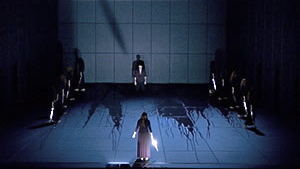
TORONTO - In a remarkable production of Orfeo ed Euridice last season for the Canadian Opera Company, director/lighting designer Robert Carsen proved he knows how to find the heart of operatic tragedy — and break it. Now, as if to underscore to hometown audiences what he has proven conclusively to the opera world at large — mainly, that his genius seems to know no bounds — he returns with a production of Christoph Willibald Gluck’s IPHIGENIA IN TAURUS that, if possible, takes an audience even further into the dark heart of classic tragedy.

In a production created for the Lyric Opera of Chicago, the San Francisco Opera and the Royal Opera House Covent Garden that opened at the Four Seasons Centre Thursday, Carsen and an impressive cast take an audience so deeply into the dark nightmare of Euripides’ final chapter of the saga of the family Atreus that you might actually feel you’ve enjoyed two and a half hours of REM sleep by the time it ends.

For those a little misty on the details of Greek tragedies, this is the final installment of the story of the tragic daughter of King Agamemnon and Clytemnestra, whose supposed sacrifice at her father’s hands has already led her mother to murder her father, and her brother, the beloved Orestes, to then murder his mother.

Meanwhile, Iphigenia, — sung here with brilliant clarity, depth and passion by soprano Susan Graham — has not in fact been sacrificed to the goddess after all, but rather been whisked to Tauris, where, under the iron hand of Scythian King Thoas (bass-baritone Mark S. Doss in full menace mode), she serves as Priestess to Diana, sacrificing, at the King’s command, every stranger that happens into his kingdom.

And this being Greek tragedy, it’s almost inevitable that the shipwrecked Orestes (baritone Russell Braun in magnificent voice) wash up on Tauris’ shores with his best friend Pylades (tenor Joseph Kaiser in a beautifully modulated performance). Both men are sentenced by the king’s command to sacrificial death at Iphigenia’s hands, but, moved by his obvious suffering, Iphigenia decides to save Orestes despite the fact that neither of them realize the blood bond. Burdened as he is, however, with the guilt of having murdered his mother, Orestes wants to die, creating one of those theatrical Gordian knots that can only be unravelled by divine intervention.

Building on Gluck’s enduring music, served up by the COC Orchestra under the baton of an impressive Pablo Heras-Casado as much as on the strength of this impressive cast, Carsen uses a largely monochromatic palette enhanced by the rich shadows created by his evocative lighting to constantly underscore the stark horror of the story.

With the COC Chorus performing off stage, he arranges his supporting cast and a corps of highly disciplined and beautifully matched dancers in a series of ever-shifting tableaux that reflect both the physical and emotional turmoil that is unfolding on stage — Braun’s Orestes, at one point tormented beyond endurance by his conscience, actually seems to be climbing walls.

As anyone who caught Carsen’s production of Orfeo can attest, this is not a director nor a design team — Tobias Hoheisel (set and costumes), Peter Van Praet (lighting) and Philippe Giraudeau (choreography) — that deals in the extravagance of conventional operatic spectacle. So if you’re looking for pretty, give this one a pass. But if you’re hungering to experience magnificent opera on a level almost completely visceral ...