Wednesday, October 27, 2010


MUSICAL THEATRE REVIEW: PRISCILLA QUEEN OF THE DESERT: THE MUSICAL
26 Oct'10

JOHN COULBOURN - QMI Agency
Rating: 4.5 out of 5

TORONTO - There are eight buses a week out of this town -- and you should be aboard one of 'em. We're not talking the Red Rocket or even Greyhound, however.

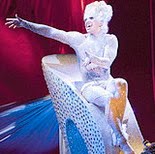
We're talking a bus named Priscilla, also known as the Queen of the Desert, made famous in the hit movie that bore her name, as in PRISCILLA, QUEEN OF THE DESERT. Now, she's back on the road, playing in musical theatre form, at the Princess of Wales Theatre, where -- having conquered Australia and London's West End -- she launched herself Tuesday on the road to Broadway. The production sported enough glitz and feathers to re-upholster a decade worth of Pride Parades, and more six packs than your local beer store.

Adapted by Stephan Elliott (who wrote and directed the movie) and producer Allan Scott, PRISCILLA QUEEN OF THE DESERT: THE MUSICAL is true to its roots in much the same way as the old Classic Comics were to the novels that inspired them -- which is to say, it hits all the high notes of the tale in a highly visual way. Anyone expecting nuance or subtlety should know to avoid drag shows, in much the same way they no doubt avoided Classic Comics.

Classic Comics, however, never came with soundtracks and it is the music in this particular jukebox musical that fans are almost certain to enjoy -- a medley of '80s hits from Madonna (Like a Virgin), Cindy Lauper (Girls Just Wanna Have Fun), The Weather Girls (It's Raining Men), Gloria Gaynor (I Will Survive) and Alicia Bridges (I Love the Night Life), with a bit of swing, a bit of opera and a bit of country thrown in for good measure. Some of it is lip-synched, performed by Jacqueline B. Arnold, Anastacia McClesky and Ashley Spencer and mimed by drag queens determined to make it their own, but a lot of it is actually sung as opposed to merely channelled.

For those unfamiliar with the turf, PRISCILLA tells the highly episodic story of three drag queens -- Bernadette, an aging transsexual played by Tony Sheldon; Tick, a reformed bisexual played by Will Swenson; and Adam, a young gay Lothario played by Nick Adams -- travelling across the Australian Outback to Alice Springs in the bus of title. At the end of their trip, there is a gig at the local casino, and a reunion between Tick and his young son, conceived, it seems, back in the days when his gate swung both ways.

Bernadette, for her part, is grieving the loss of a lover, while Adam has long had a fantasy involving a frock, a rock (in this case Uluru, formerly known as Ayers Rock) and a -- well, we'll leave the rest to your imagination. Along the way, the trio encounters and fabulously faces down a few demons, both personal and societal, with Priscilla playing inadvertent matchmaker when she breaks down and requires the ministrations of a courtly mechanic named Bob (C. David Johnson) who's about to make like a ping-pong ball and bounce right out of his marriage.

Under the direction of Simon Phillips, with choreography by Ross Coleman, this is the granddaddy of all drag shows, dressed up like its grandmammy, thanks to the costumes of Tim Chappel and Lizzy Gardiner, who in the main eschew the female impersonation of 'classic drag' in favour of a sort of performance androgyny. Reviewed here in preview, this is, not surprisingly, a show that delights in the outrageous and the flouting of convention -- but it also remains oddly chaste for all that, a nod perhaps to too tender middle class sensibilities that can ultimately make or break a musical like this.

All four of the principals thankfully prove to be very dab hands at fleshing out sketchy characters, supported by a hardworking ensemble featuring performers such as J. Elaine Marcos and Keala Settle, each of whom comes close to stealing the show with small but memorable turns.

Shiny as a zirconia sunburst, and deep as a dime, PRISCILLA turns theatrical convention into theatrical confection at every turn -- a show that gives you a good time but still makes you think you might want to take her home to meet mama anyway. Assuming, of course, that mama has a broad mind and a great sense of humour -- or a very good pacemaker.

Tuesday, October 26, 2010

OPERA NEWS: Banner year for COC
26 Oct'10

JOHN COULBOURN - QMI Agency

It was a banner year for the Canadian Opera Company, with acclaimed productions and better than brisk ticket sales. The COC also managed to make a bit of money in the process. At the annual general meeting on Tuesday, board president Paul Spafford announced the company had enjoyed a record-breaking season in 2009-10, finishing with a modest surplus of $21,000.

With 70 performances of seven operas, including the world premiere of Robert Lepage’s THE NIGHTINGALE AND OTHER SHORT FABLES, the COC set a record for season-ticket revenues, up year over year by 6.2% for a total of more than $13 million. That represents more than 50,000 single tickets and 97.6 % of capacity.

But ticket revenues cover only 41% of the company’s annual budget. The remainder comes from government grants (including increased amounts over the previous year from the Ontario Arts Council and Toronto Culture), from space and production rentals and, finally, from donors, whose portion accounts for some 28%. Spafford praised the people “who believe the COC is worth supporting, beyond simply purchasing a ticket or a subscription. And those that do,” he continued, “are, thankfully, very generous in their support.”

By contrast, in 2008-09 the COC was forced, despite a banner year from a production point of view, to dip into reserves to the tune of $1.6 million in order to finish the year with a $25,000 surplus.

The COC also announced Tuesday that it will once again produce broadcasts of its entire season, in conjunction with CBC Radio 2, making them accessible to both national and international audiences. This marks the second year in a row for the arrangement.

Friday, October 22, 2010


THEATRE REVIEW: THE ANDERSEN PROJECT
22 Oct'10

JOHN COULBOURN - QMI Agency
Rating: 4 out of 5

It's tough to think of anyone in the modern theatre world who has done more to prove the veracity of Shakespeare's observation that "All the world's a stage" than Robert Lepage. In a career spent mining the world and all that's in it for theatrical subjects and effects, Lepage has done much to change not only the way we see theatre, but the way we see the world as well.

Now, in THE ANDERSEN PROJECT, Lepage gives us the opportunity to study, at our leisure, the way he can blend some of the most ancient theatrical effects with some of the most modern to expand the theatrical stage so that it seems indeed to embrace all the world. In Lepage's world, shadow puppetry, no doubt first experienced on the walls of a cave, blends almost seamlessly with the latest innovations from the world of video to create a magic carpet that is capable of carrying us anywhere the master storyteller wants to take us.

Commissioned by the Danish government in 2005 to mark the bicentennial of the birth of that country's most beloved writer, Hans Christian Andersen, it obviously has taken a while for THE ANDERSEN PROJECT to make it to Toronto -- but, happily, it's now ensconced for what is likely to be a too-brief run at the Bluma Appel Theatre, where it opened Thursday night. It's a Canadian Stage presentation of an Ex Machina production.

And while TAP is certain to teach anyone who is not an Andersen scholar a few choice things about the Danish master of fables -- his wretched track record with women, his attraction to men and an addiction to onanism that we'll simply have to take on faith -- this is not a biography of Andersen, who is, in reality, reduced to a supporting role. Instead, it tells the story of a young Quebecois songwriter who, in the wake of a romantic upheaval, finds himself in Paris writing the libretto for a children's opera adapted from one of Andersen's tales and baby-sitting a drug-addicted dog, at least temporarily in estrous.

His Parisian interlude also introduces our homegrown hero to a babbling French bureaucrat who is, apparently, like Andersen, devoted to self-pleasure, as well as to a sullen Algerian graffiti artist who earns his living cleaning up what customers at a Paris peep show leave behind. Their stories, interwoven with a few of Andersen's fables, become the stuffing of TAP, an occasionally rambling single act that spans more than two hours.

All of these characters, with the exception of the dog, are played by a single actor -- renowned Quebecois artist Yves Jacques, stepping into the roles created and originated by Lepage and tossing them off with the skill and grace of a dancer. Jacques also works seamlessly with all the theatrical elements Lepage and his team have incorporated into the tale. Many of them foreshadow later works in the master's canon -- a bit of shadow puppetry that resurfaces in a more refined way in THE NIGHTINGALE AND OTHER SHORT FABLES, a bit of stage alchemy that tries to turn two dimensions into three. Clearly, Lepage was exploring ideas he expanded in his RING CYCLE.

Like all of Lepage's work, it is marked by a standard of theatricality rarely equalled, but it stops short in this instance of being great theatre, marked though it is with plenty of Lepage's irreverent wit. Larded with wanker jokes and references to France's fractious unions, it still feels as if Lepage is struggling to stretch his subject matter. Sometimes, he abandons his audience to long Fren-glish monologues that are all but unintelligible in either official language. At others, he allows his story to wander while he experiments with another usually spectacular effect.

As a result, THE ANDERSEN PROJECT stops short of must-see theatre, but with the Lepage imprimatur, it is nonetheless must-see theatricality.

THEATRE REVIEW: DEATH OF A SALESMAN
22 Oct'10

JOHN COULBOURN - QMI Agency
Rating: 4 out of 5

Good plays are often defined by their time . A great play is timeless — and Arthur Miller's DEATH OF A SALESMAN is a truly great play. Just how great, in fact, is more than evident in the Soulpepper production that opened Thursday at the Young Centre, directed by Albert Schultz.

Save for a certain precise beauty in the language (tragically fallen from fashion in the past 60 years), the play and its protagonist are very much of today's world. Willy Loman, the man who sits at the heart of this modern tragedy, could be one of the millions of people who today look back on a lifetime of hard work and playing by the rules, and wonder: "What the hell happened."

And when the long-suffering Linda Loman, Willy's wife, insists: "Attention must be paid," there are echoes of the same rage and frustration that's blossomed in today's disaffected electorate, seemingly prepared to throw the baby out with the bath water, hoping for something better. But while the play itself is still hugely powerful — perhaps even more powerful than at any time since it premiered in 1949 — Soulpepper's often-worthy production is impressive on many fronts, though flawed. Reviewed here in it's final preview, it features some truly magnificent performances in its principal roles.

Joseph Ziegler is cast as Willy , the Salesman of title, and, not surprisingly, he is superb, embracing his character's flaws and making them strengths as he careers backwards and forwards in time like some sort of aged and wounded bull elephant looking for a place to die. His Willy may have a skewed vision of the world, but he has played by the rules as he sees them, only to discover in the final act , that the rules have changed. Thanks to Ziegler's performance we not only understand his sense of betrayal, we feel it as well.

As his sons, Biff and Happy, Ari Cohen and Tim Campbell respectively, match Ziegler at almost every turn, throwing themselves into their performances with a fearlessness shot through with both intelligence and pain. As Biff, Cohen skates constantly on the edge of despair, while Campbell brings a deep bravado and sympathy to his portrayal of the hapless Hap.

As Willy's long-suffering wife, Nancy Palk (Ziegler's real-life wife) gives a valid performance too, although her St. Linda of Loman routine wears more than a little thin by the play's end, robbing her character of backbone and her graveside farewell of much of its power.

But while the Loman family springs to vital life on Lorenzo Savoini's cramped but effective set, Schultz is not nearly as effective with the performances he draws from his supporting cast. From William Webster's strangely foppish turn as the ghostly Uncle Ben, through Brendan Wall's oddly contemporary turn as Howard, Willy's brash and self-involved young boss, Schultz seems content to allow fine performances from his principals to serve as support for his supporting cast, making do with good enough, in a work where good enough simply isn't good enough by half. While his pacing is right on the money, one wishes he'd spent a little more time shaping things and not just moving them along.

Still, few can deny that Miller's timeless script triumphs over the often minor missteps in this production. For all that it may not be a perfect production of DEATH OF A SALESMAN, it is nonetheless a DEATH OF A SALESMAN for our time, and when a show like this comes along, attention must be paid.

To borrow a phrase.

Thursday, October 21, 2010


OPERA: FEATURE INTERVIEW

Set designer Gauci recalls big break
20 Oct'10

JOHN COULBOURN - QMI Agency

You never know where that next step is going to lead you: A few feet ahead, or a whole new life. Just ask Gerard Gauci. A quarter century ago, he was a recent graduate of the Ontario College of Art and Design, eking out a living as an illustrator. In that capacity he found himself charged with designing a cover for what he describes as "a now-defunct CBC Radio guide."

The result owed more than a passing debt to the baroque period and, lovely though it was, would no doubt have been forgotten had it not caught the attention of a pair of artists who were fascinated with all things baroque. They ripped the cover off the magazine and stuck it on their fridge, where it was noticed by a friend of theirs and of Gauci's, who proceeded to give Marshall Pynkoski and Jeannette Lajeunesse Zingg a telephone number where Gauci could be reached.

"They called out of the blue and asked if I'd have tea with them," Gauci recalls, by way of explaining his 25-year association with Opera Atelier, the Toronto-based baroque opera company formed and nurtured over the past quarter century by Pynkoski and Zingg. And Gauci, whose cover sketch landed him a job that would eventually morph into his being named OA's resident set designer, has gone along for the ride. In fact, you could say he has been responsible for the look of that ride, as the fledgling company outgrew the AGO's Walker Court and the Macmillan Theatre, before coming to roost in the opulent confines of the Elgin Theatre, where it still makes its performance home.

"I've been able to grow along with them," says Gauci, who admits that while growing up in Etobicoke he "intended to work in theatre, and got waylaid. I've grown with them. That was the wonderful thing about coming in on the ground floor. I've just had to learn as we grow, and I'm still always learning."

Indeed he is. Starting with the Elgin's Oct. 30 opening of OA's ACIS AND GALATEA, audiences are going to see a whole new dimension to Gauci's talents. For the Handel classic, Gauci is not only working his magic on the sets (he has proven himself a dab hand at trompe l'oeil over the years) and props (including a flock of mechanical goats that will gambol across the stage at will), this time out he also has taken responsibility for the costumes. As if he didn't have enough on his plate.

"Every once in a while, I like to take on something that's very difficult -- and this is," he says, adding that costuming adds a whole new layer to things. "You can do a perfectly nice sketch, but it's not about sketching." he says. "The thing that is most different (is that) it all happens in the last few weeks." So, in addition to worrying about the sets and props, he's now embroiled in fittings, tailoring and a thousand other concerns. But if Gauci seems to be taking it all in his stride, it's because of past experience. "At the beginning of every show, I'm always nervous about how it's going to go," he admits with a quiet smile. "But it always works out, if you have a good team. And I have a great team."

Gauci has designed more than a dozen shows for OA, but through it all he has built a successful career as a painter, as well. His work has been exhibited across Canada and featured in several prestigious collections. Maintaining two careers, Gauci says, isn't so much a matter of keeping them separate as using them to complement each other. "The biggest difference is your paintings are always about your very personal experience," he says, "but your design work is very collaborative. Painting is about me." And while he says he enjoys the work that is all about him, "I'm also very happy to open that door and start working collaboratively, It's a very different experience and a very refreshing one. It's great to shift back and forth."

As an artist, Gauci may be singing out of two different songbooks, but he quite happily designed the cover for both, 25 years ago.

Gauci, Pynkoski partnership works:

Ever wonder what it would be like to work with a larger than life personality? Ask Gerard Gauci, the resident designer of Opera Atelier. He's been been working with the ever-ebullient and always-enthusiastic Marshall Pynkoski since the baroque opera company was little more than a dream.

"I don't find working with him hard," Gauci says happily of the man whose enthusiasm for his company flows over the audience at the top of every OA performance. Indeed, Gauci welcomes that kind of enthusiasm "I find it really stimulating," Gauci says. "The hardest thing is going to function and not talking about work. The wonderful thing about (Marshall) is he gives as much as he takes -- probably more."
________________________

Wednesday, October 20, 2010

THEATRE NEWS: Soulpepper seasons 2011
20 Oct'10

JOHN COULBOURN - QMI Agency

Seems Soulpepper is turning into a spice to be applied to the Toronto theatre scene in a most liberal fashion. At least that's the impression in the wake of artistic director Albert Schultz's announcement Tuesday of his company's new 17-show 2011 season at the Young Centre.

Of those 17 shows, five will be remounts of earlier Soulpepper productions — Thornton Wilder's OUR TOWN, Neil Simon's ODD COUPLE, Miklos Laszlo's PARFUMERIE (adapted by Adam Pettle and Brenda Robins) William Saroyan's THE TIME OF YOUR LIFE and John Gray and Eric Peterson's BILLY BISHOP GOES TO WAR.

But Soulpepper artists will also be hard at work focusing their attention and ours on other classics of the theatre canon, including David Mamet's OLEANNA, William Shakespeare's A MIDSUMMER NIGHT'S DREAM, Tennessee William's THE GLASS MENAGERIE, Eugene Ionesco's EXIT THE KING, Arthur Miller's THE PRICE , Henrik Ibsen's GHOSTS in a new translation/adaptation by Morris Panych, and for musical theatre fans, THE FANTASTICKS, by Tom Jones and Harvey Schmidt.

As for Canadian content, well Soulpepper has got that covered too, with new productions of Guillermo Verdecchia's FRONTERAS AMERICANAS and Judith Thompson's WHITE BITING DOG planned, in addition to a pair of one acts: THE ALEPH, based on a short story by Jorge Luis Borges and adapted by Diego Matamoros and Daniel Brooks and Leo Tolstoy's THE KREUTZER SONATA, adapted by Ted Dykstra. A double bill — (Re)Birth: e.e. cummings in Song, and WINDOW ON TORONTO, directed by Laszlo Marton — round out the season.

Soulpepper subscriptions can be renewed after Oct. 18, with new subscription available Nov. 2 and single tickets, Nov. 23. For further information, call 416-866-8666 or visit soulpepper.ca.

Monday, October 18, 2010


THEATRE: FEATURE INTERVIEW
18 Oct'10

‘Priscilla’ actor takes a step back

JOHN COULBOURN - QMI Agency

In the often topsy-turvy world of theatre, it makes perfect sense that one of the Canadian musical stage's most successful leading men is preparing to head to the Big Apple, lured there in no small part by the chance that he just might become one of Broadway's leading ladies And if that has you scratching your head, then maybe you haven't been playing attention to the developments at the Princess of Wales Theatre, where a Broadway-bound company is about to open the Canadian premiere of PRISCILLA, QUEEN OF THE DESERT: THE MUSICAL.

It is, of course, based on the hit movie PRISCILLA, QUEEN OF THE DESERT, and if you check the chorus credits when it opens in Toronto on Oct. 26, you might be surprised to find the name Thom Allison there. Yes, that would be the same Thom Allison who has delighted Canadian audiences in a range of roles, from Cinderella's Prince Charming in the Stratford Festival's acclaimed production of INTO THE WOODS, to Carl Magnus in the Shaw Festival's A LITTLE NIGHT MUSIC, to Darren in CanStage's TAKE ME OUT, to Adolpho in THE DROWSY CHAPERONE at the Manitoba Theatre Centre, the Vancouver Playhouse, the Citadel and the National Arts Centre.

Allison doesn't see the fact that he's once more a chorus boy as a step down, but he admits it is a bit of a step backward -- as in stepping into the background. But he also sees it as a step in the right direction -- right toward New York. "Honestly, the deciding factor instantly was: "I'm going to Broadway!' he says. To get there for the March 2011 Broadway opening, taking a part in the chorus was a small price to pay. "And if I have to go into the ensemble at this point in my career, what a show..."

But the full truth of the matter is, while he's stepping back into the ensemble, he's also got an opportunity. Allison has signed on to understudy the role of Bernadette, the transsexual den mother to a pair of drag queens traveling across Australia on a broken-down old bus named Priscilla. It's a role originated in the Australian production by Tony Sheldon, who went on to earn a best-actor nomination for an Olivier Award in the subsequent London production. And although Sheldon is planning to stay aboard the Priscilla bus as it roars through Toronto on its way to its Broadway debut, Allison is not unaware of the possibilities Sheldon's understudy might face in the future, in a show that already has other international productions in the planning stages.

"It's a mix of trepidation right now," Allison says, "because I'm trying to learn (the part). Tony's incredible. He's been so generous about giving tips." But even if Allison never gets the chance to play Bernadette on the New York stage, he's still firmly on board for the move to the Big Apple, and happy to be there.

"A big part of New York for me is the cabaret scene -- and I want to explore that," he insists, adding that, while he still loves acting, he has an increasing fascination with that particular aspect of showbiz. "I love the idea that it's an evening about me, and doing what I want to do. That way I can be passionate about every song. What I love to do is be a singing storyteller. I love to weave a spell over an audience and take them on a ride."

For now, that ride is aboard Priscilla, but who knows where this bus will stop?

Walking the wild side not a drag for veteran actor:

Drag is no big thing for an actor such as Thom Allison -- and a good thing too. "I love transformation -- the whole male/female stereotype," Allison says as he prepares for the opening of PRISCILLA, QUEEN OF THE DESERT: THE MUSICAL, adding: "They're not always such polar opposites as people would think." In fact he welcomes the chance to get dressed up and walk on the wild side again, more than a decade after starring in OUTRAGEOUS.

"OUTRAGEOUS was about a Canadian (famed female impersonator Craig Russell), so there was a certain respect. It wasn't about doing drag, it was about the person," he says. "Now, it's just fun, because it's so chic. It's the jewel that people want to find out about. It's a wonderland. It's Alice Through The Drag Looking Glass."

And thanks to shows such as Priscilla, it's the audience that just gets more curious all the time, he says. "(This show) is a safe way to step out of their comfort zone," he says.