Sunday, May 27, 2012


THEATRE REVIEW:
PRESENT LAUGHTER


JOHN COULBOURN,
Special to TorSun
24 MAY 2012
R: 3.5/5


Pictured: Steven Sutcliffe, Claire Jullien

NIAGARA-ON-THE-LAKE — Noel Coward, playwright and bon vivant, often dismissed his prodigious creative gifts as simply “a talent to amuse” — and judging from a new production of one of his plays, his death, in 1973, did little to diminish that talent. In fact, the production of Coward’s 1942 play, PRESENT LAUGHTER, that launched a new season of the Shaw Festival on the Festival Stage Wednesday, is often amusing — at least when director David Schurmann puts his trust in the playwright and simply lets Coward work his magic as he spins a spoonful of plot into a towering comedic confection.

But welcome as they are, those occasions are too often overshadowed in a production that has its problems, not the least of which is the casting of Steven Sutcliffe in the pivotal role of leading man Garry Essendine, a larger-than-life actor the playwright freely admitted was patterned after himself. While the talented and self-effacing Sutcliffe has often proved himself an actor with whom to conjure, he comes up short here, successfully inhabiting the character of Essendine in every way, save the one that would bring him completely to life. In the final analysis, he lacks the ability to get outside himself and watch his performance with the same adoration that his audience watches it, and Essendine is in every way his own biggest fan.

Simply stated, Sutcliffe is an actor who works and works hard for his audience’s affection, while the role of Essendine demands an actor so confident of that affection that he will play with it instead. That said, Schurmann finds some nice stuff in an often elegant production, thanks to a cast the includes Shaw regulars like Gray Powell, Claire Jullien and Moya O’Connell, all following the example set by two of the Festival’s most enduring leading ladies — specifically Mary Haney and the venerable Jennifer Phipps, both of whom give ample demonstration here of the truth in the adage that there is no such thing as a small part. And while Julia Course, James Pendarves and Patrick McManus fail ultimately to impress, under Schurmann’s direction, they at least manage to make it through the production without slowing it down.

But, while Schurmann finds memorable things in this delightful stage confection, he too often seems to forsake both play and playwright, setting aside Coward’s elegant and charming tale of a leading man who sees the whole world as his stage in favour of a kind of self-absorbed buffoonery completely at odds with a playwright who elevated wit and elegance to a religion. One might, for instance, forgive Corrine Koslo’s heavy-handed attempts to steal scenes as Essendine’s housekeeper Miss Erikson. But when that kind of over-acting is coupled with the silly, childish rambunctiousness Jonathan Tan brings to his performance as pushy playwright Roland Maule, it adds up to such a surfeit of bad acting that the very fabric of the play is threatened.

On the plus side designers William Schmuck (sets and costumes) and Kevin Lamotte (lighting) do a bang-up job of creating an elegant London studio as setting for the unraveling of Essendine’s life — and if Schurmann fails to achieve the consistent light and elegant touch that would bring Coward’s work to life, he does at least manage on occasion to shed a bit more light on a great man’s enduring talent to amuse. 

Monday, May 21, 2012


THEATRE REVIEW: HOME

JOHN COULBOURN,
Special to TorSun
20 MAY 2012
R: 4/5


Pictured: Oliver Dennis, Michael Hanrahan

TORONTO - When it comes to defining them within the context of modern life, words like ‘home’ and ‘family’ have proved impressively adaptable, stretching themselves to embrace almost anyone’s personal interpretation of what they might be. In fact, the fluid nature of home and, to a lesser degree, of family (at least, in terms of the family of man), was something British playwright David Storey explored as long ago as 1970 in a quirky little comedy titled, appropriately enough, HOME. And now Storey’s play is making itself at home here in Toronto where it opened last week on the stage of the Young Centre in a new Soulpepper production, helmed by artistic director Albert Schultz.

With Soulpepper regulars Oliver Dennis (truly golden in his 50th Soulpepper turn) and Michael Hanrahan in the roles of Jack and Harry, famously played in the work’s première by British greats Ralph Richardson and John Gielgud respectively, it certainly begins well as the two meet on an elegant, if somewhat gone-to-seed terrace in an un-named park.

Under a cloud-strewn sky created by set and costume designer Ken MacKenzie and lighting designer Lorenzo Savoini, the two exchange banalities and, in the process, offer up clues to an upper middle class life as they discuss military service, mutual acquaintances, the demise of the walking stick and, of course, the “sceptred Isle” that is their home. And yet, the playwright implies with often subtle humour, all is not right in their world and we’re not just talking the decline of the British Empire that they periodically lament. That fact becomes increasingly evident when they abandon their conversation in favour of a stroll around the park.

In the process, they surrender their seats to the sunny Kathleen (Brenda Robins) and the stormy Marjorie (Maria Vacratsis), a pair of working-class drabs who are, it is quickly evident, a few fish and chips short of a full basket. Amongst the legion of problems their conversation reveals is Kathleen’s rather over-active libido, which means the when Jack and Harry return, the foursome is quickly fused into a sort of family of convenience. Not only do they look out for each other, they successfully fend off the incursion by Alfred (André Sills), another occasional denizen of their shared and increasingly claustrophobic territory  — a claustrophobia slowly revealed as something far less bucolic that it initially seems.

Of course, it’s all a metaphor for what passes for civilization in a nation, or perhaps a world, gone mad — a tale that still amuses even while it grows progressively darker and more disturbing. But while Schultz captures much of Storey’s dark whimsy in the early portions of the production, he is less successful as things get more and more complicated. Under his direction, the normally impressive Robins makes her entrance, badly wigged and shrieking like a refugee from a particularly rambunctious Carol Burnett sketch and sadly is rarely allowed to explore Kathleen’s humanity, her very obvious problems reduced to simple grist for the laugh mill.

Being Robins, she’s still a worthy foil to the three other finely drawn performances here, but, ultimately, it unsettles the balance of this delicate and more-than-slightly absurdist work and proves conclusively when you enter David Storey’s world, HOME can only be where the heart is.

Sunday, May 20, 2012


THEATRE REVIEW:
LOST IN YONKERS


JOHN COULBOURN,
Special to TorSun
19 MAY 2012
R: 3/5

LOST IN YONKERS may not be, as some suggest, the best play Neil Simon ever wrote — although it did earn him a Pulitzer Prize — but few can argue that the beloved American playwright built the play around one of the most enduring dramatic characters he ever imagined. Few dramatic roles in the modern canon prove as demanding as LIY's Grandma Kurnitz — a character that must not only dominate the stage for the time she's on it, but before she enters it and after she leaves it, as well. To tackle the role of Grandma K, Harold Green Jewish Theatre has recruited Marion Ross (aka Happy Days' Mrs. C) in a production that opened at the St. Lawrence Centre Thursday.

Set during World War II, LOST IN YONKERS plays out in the home of Ross's Grandma Kurnitz, a home shared with her damaged daughter, Bella (Linda Kash), a perpetual child, trapped in a woman's body. And even though he fled this home and Grandma Kurnitz's iron will at the first opportunity, Grandma's grown son Eddie (David Eisner)  has, in the wake of his wife's death, brought his two young sons — Jay (Alessandro Costantini) and Arty (Jesse Shimko) — to his mother in desperation, hoping she will care for them while he takes to the road to pay bills that accrued during his wife's illness.

But time has not softened the heart of a woman who terrorized her own children, and though, at Bella's urging, the disagreeable old matriarch agrees to take the two boys into her home, she makes it clear she will not take them into her heart. They will work, as unpaid help, in the store she runs downstairs, and they will live according to her unbending rules — and not even the arrival of the boys' raffish Uncle Louie (Ari Cohen) and their troubled Aunt Gert (Sheila McCarthy) will soften her rule.

Working with actors almost all of whom are a trifle mature for their parts, director Jim Warren does his level best to set things right, maintaining a brisk, business-like pacing as the story unfolds on a serviceable set created by Sue LePage and lit by Lesley Wilkinson. But ultimately, this otherwise-accomplished director seems to think this is simply another Neil Simon comedy, when in fact, what he has on his hands is perhaps Simon's only drama — and while there are comedic overtones at play here, a successful director must focus on that drama, certain that the comedy will take care of itself.

Under his direction, the venerable Ross succeeds in offering occasional glimpses into the troubled soul of the complex Grandma Kurnitz — an embittered German Jew who traded a life of hard work and grinding poverty in Berlin for a life of hard work and grinding poverty in Yonkers. But ultimately, she fails to create a cohesive portrait of a woman who triumphs through endurance.

Kash too does some fine work, only to be undone by a comedic touch too broad by half, all of which leaves an impressive Cohen and the always watchable McCarthy to team up with Eisner's care-worn Eddie to balance two fine performances from Costantini and Shimko. Sadly, for fans of Neil Simon, this production of LOST IN YONKERS shows up on stage more than a little lost in translation.

Thursday, May 10, 2012


THEATRE REVIEW: HIGH

JOHN COULBOURN,
Special to TorSun
10 MAY 2012
R: 4/5


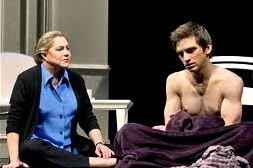
Pictured: Kathleen Turner, Evan Jonigkeit

In HIGH, playwright Matthew Lombardo trots out age-old notions of faith, hope and charity for a contemporary romp around the track — and while it all ends in a bit of three-horse pile-up, the play is still a compelling, at times, even engaging horse race. On the surface of things, HIGH, which opened a very limited run at the Royal Alexandra Theatre Wednesday, is a play about addiction, involving as it does, a prolonged effort to save one young man from the demons of drug abuse and the horrors that led him there. But on another — not necessarily deeper — level, it is also a play about the power of faith, the cost of hope and the human price of charity.

Set in a church-run centre for drug addiction, it is the story of the foul-mouthed Sister Jamie (played by Kathleen Turner) and her efforts to free young Cody Randall (Evan Jonigkeit) from the a world of drug abuse and prostitution — a world he’s inhabited since childhood, sharing it with demons with very real and familiar faces. Initially, Sister Jamie is a less-than-willing participant in the battle, dragooned into it as she is by Father Michael (Tim Altmeyer), her spiritual and temporal boss, who has, it develops, more than a passing interest in her success or failure of the young man’s treatment.

In creating HIGH, Lombardo has crafted an undeniable showcase for a mature actor of Turner’s range, and, under the direction of Rob Ruggiero, she makes the most of it, tearing into the role of the troubled nun-with-a-past with a vengeance and finding a deep reserve of humour in the process. Sister Jamie’s prickly personality and her humanity are both given flesh in Turner’s hands as she spits out dialogue in short, staccato sentences that, while highly effective, have little to do with writing and punctuation.

There’s quality work from Jonigkeit too, as he fearlessly inhabits the dark world of his character, filling it with a potent combination of knowingness and innocence that keeps his audience on-side despite his obvious bent for self-destruction. Under Ruggerio’s direction, even Altmeyer, lumbered as he is with a role that exists largely to advance the plot, succeeds in making his mark, adding intimations of darker shadings of humanity to the role of the good-natured-but-troubled priest at every turn.

But ultimately, despite a reported major reworking of the script since its less-than-successful Broadway run, HIGH remains far more interesting and compelling for the power of its performances than its plot. In the final analysis, while it purports to examine issues of faith and human charity, it fails to confront them, retreating too often into the comfortable inside argot of clerics and social workers instead of bringing things to the street level where most of us live.

And despite a deeply moving performance by Jonigkeit, his Cody fails to exhibit not only the physical ravages of his abusive and abused life — stripped down, he’s frankly more likely to be mistaken for a steroid abuser than a junkie — but the emotional ones as well. In a tough-love world where the battle is all too often centred on finding a soul in the human wreckage, he seems to have a surfeit of it, and in consequence, even though HIGH aims to be a play about saving fallen sinners, it emerges as a play about saving fallen saints instead. 

MUSICAL THEATRE REVIEW:
WEST SIDE STORY


JOHN COULBOURN
,
Special to TorSun  
10 MAY 2012 
R: 4/5

Pictured: Evy Ortiz, Ross Lekites

TORONTO - Rather than dimming with the passage of time, the genius that illuminated the 1957 première of WEST SIDE STORY seems to burn brighter with each passing decade. That's tribute, one suspects, not only to the enduring brilliance of William Shakespeare, whose Romeo and Juliet inspired this classic, but to the creative power of the collaboration that adapted his play to the musical stage -- playwright Arthur Laurents, composer Leonard Bernstein, lyricist Stephen Sondheim and director/choreographer Jerome Robbins. And happily, the power of that collaboration shines brightly in an occasionally-flawed-but-ultimately-powerful production of the show that opened at the Toronto Centre for the Arts Wednesday, part of Dancap's ongoing season.

Reviewed here in its Tuesday preview, this is a touring production of the 2009 Broadway revival, in which the late Laurents not only assumed the director's mantle, but reworked some of the dialogue as well to deepen the Hispanic element of the story. In the main, Laurents' reworking -- which has members of the Puerto Rican gang, the Sharks, speaking Spanish amongst themselves -- plays well for an audience that has had half a century of not-always-positive television portrayals of Hispanic youth to broaden its horizon since the show debuted. But from a directorial point of view, Laurents cleaves fairly closely to not only the choreography but the stage vision originally created by Robbins, spinning out the story of the tragically ill-fated romance between the Polish-Irish Tony (played by Ross Lekites) and the Puerto Rican-born Maria (Evy Ortiz).

It's a romance torn apart by gang warfare between the Jets -- who count Tony as an increasingly reluctant member and comprised mostly of the children of Irish and Eastern European immigrants -- and the Sharks, led by Maria's brother, Bernardo (German Santiago) and comprised of the kids of the more recent Puerto Rican migration to New York.

Under the direction of  David Saint, who recreates Laurents' vision for the road, and working with choreographer Joey McKneely (recreating the style of Robbins' original choreography, if not its menace), the extensive cast claims James Youmans' wonderfully down-at-the-heels evocation of Manhattan with plenty of energy, basking in the glow of Howell Binkley's masterful lighting. From the pit, John O'Neill leads the orchestra through a timeless score that includes such musical gold as Something's Coming, Maria, Tonight, I Feel Pretty and Somewhere.

As Tony, Lekites seems rather stolid 'til he opens his mouth and soars to those high notes, while as Maria, Ortiz blends a wonderful innocence with a youthful soprano voice. They are supported by some fine performance from the likes of Santiago, Michelle Aravena (as Bernardo's girlfriend, Anita), Drew Foster (as Tony's best friend Riff) and the diminutive Alexandra Frohlinger -- who, as Anybodys, tears into Somewhere (originally sung from offstage) as an anthem for all the world's outsiders. On the downside, in minor roles, John O'Creagh's Doc, Wally Dunn's Krupke and Mike Boland's Lt. Schrank all seem a touch road-weary, while Stephen DeRosa is all but unforgivable in his turn as Glad Hand. In the end, in the pantheon of memorable tellings, this one stops just shy of greatness, but a production of WEST SIDE STORY that is merely pretty damn good is still well worth seeing.

Friday, May 4, 2012


MUSICAL THEATRE REVIEW:
BRING IT ON - THE MUSICAL

JOHN COULBOURN,
Special to TorSun
04 MAY 2012
R: 3/5

If you want to know how much theatre has changed over the years, consider this: Back in the days when Mickey Rooney and Judy Garland defined the youth of America, it was “My dad has a barn, let’s put on a show.” Today, that line might read more like “My dad has a stadium, let’s put on a show.” Which leads us inevitably to BRING IT ON-THE MUSICAL (inspired by Bring It On, the movie, which was in turn inspired by the world of competitive cheerleading). The possibly Broadway-bound musical opened a limited run Thursday in the Ed Mirvish Theatre (formerly the Canon).

First off, for those unfamiliar with such things, it should be noted that cheerleading has changed from the days when squads were comprised of those whose gender or athletic ability precluded making the team — so much so that modern cheerleading often demands a level of athletic prowess exceeding that of the competitors being cheered. And based on Thursday night’s opening, BRING IT ON is a fine showcase for that kind of talent, filled as it is with high-flying acts of derring-do from some of America’s best cheerleaders, who comprise about half the cast. But finally, all those breath-taking gymnastics can’t really mask the shortcomings of a wickedly-derivative book (by Jeff Whitty) or a pleasant, engaging and largely forgettable score (by Tom Kitt and Lin-Manuel Miranda, the latter of whom collaborated with Amanda Green on lyrics.)

The story, such as it is, is a convoluted affair revolving around the misadventures of the lovely young Campbell (played by Taylor Louderman) who, as reigning queen of the cheerleaders at upscale Truman High, suddenly finds herself shunted aside in her senior year through the machinations of her young protégé (Elle McLemore). Exiled to the down-market Jackson High, Campbell eventually befriends the haughty Danielle (Adrienne Warren), the diva of Jackson’s dance crew, and after a few missteps, the two team up to transform dance crew into cheerleading squad and find themselves competing against Truman at the national cheering championships. Along the way, Ryann Redmond (as the full-figured Bridget) and Gregory Haney (as the funky shemale La Cienega) offer intimations that inner-city campuses might well be in the vanguard of positive social change.

But, ultimately, there’s not a single character here who is deeper than a dime, and while director/choreographer Andy Blankenbuehler polishes things to a high gloss, all that sparkle simply serves to underline the fact there is no depth to the story. Despite everyone’s best efforts, all the earnest athleticism of the cheerleaders only serves to get in the way of hitting that perfect tongue-in-cheek sweet spot that made Legally Blonde such a romp.

Meanwhile, David Korins' sets are simple and serviceable befitting a production born on the road, relying heavily on video screens and banks of school lockers to set most scenes, while Andrea Lauer’s costumes run the gamut from preppy to funky, with, not surprisingly, a heavy infusion of cheer gear all along the way. But finally, while BRING IT ON-THE MUSICAL pumps us up like cheerleaders should, it lacks an emotional touch-down to win the game — so if your dad has a stadium, the best thing to do is still to put on a game.

THEATRE REVIEW:
THE REAL WORLD?


JOHN COULBOURN,
Special to TorSun
03 MAY 2012
R: 3.5/5


Pictured: Matthew Edison, Jane Spidell

Long before writers like James Frey and Mike Daisey led us to examine the often tenuous relationship between authorship and the truth, the subject was pretty incisively dissected and explored by Quebec playwright Michel Tremblay in a play titled THE REAL WORLD?. Now, 25 years after it made its English language première at the Tarragon Theatre in a translation by Bill Glassco and John Van Burek, THE REAL WORLD? returns to the Tarragon in a production that allows a whole new audience to get a look at the play — considered by many to be amongst Tremblay’s best work.

Directed by Tarragon’s artistic director Richard Rose, this new production features an all-star cast, albeit one drawn from admittedly different constellations, combining the artistry of respected stage artists like Tony Nappo, Jane Spidell and Matthew Edison with one-time Oscar nominee, Meg Tilly, essaying what proves to be a pretty graceful leap from screen to stage.

Set in a suburban Montreal home in the ’60s (created by designer Charlotte Dean), THE REAL WORLD? begins as a confrontation between a care-worn mother (Spidell) and her grown son, Claude, a playwright (a tentative Edison). Seems Claude has written a play that lays bare some innermost family secrets, documenting not only a troubled relationship between his mother and his travelling salesman father (played by Nappo), but the equally dodgy one between his father and his sister, played by Sophie Goulet.

While his mother doesn’t dispute the cold hard facts as laid out in Claude’s play, she has serious issues with the attitudes he portrays, at the same time as she clearly resents the colossal invasion of privacy, her own and her family’s. As mother and son debate the fictional treatment of the family and, in the process, dissect his own troubled relationship with his father, the characters with which Claude has populated his play take centre stage, sharing the world with his real-life family and playing out his version of the family’s story, achieving a resolution that real life seems to have withheld.

In this alternate world, Claude’s father, Alex, is essayed by Cliff Saunders, while Spidell’s earthy and heart-breaking mother is echoed by Tilly, both adding a staginess that contrasts beautifully with Nappo’s and Spidell’s more centred performances. Cara Gee plays Claude’s troubled sister Mariette in this alternate world.

It’s a thought-provoking, sometimes touching, piece of theatre, in which the writer’s imperative is thoroughly examined within the context not just of truth, but of emotional honesty as well, while issues of privacy hang in the balance — a drama finally about family drama.  But it is also problematic in that, with two realities sharing time and space, it offers a minefield for its director —  a host of problems which frankly are not all sorted out in this too often turgid staging.

And finally, in a rather showy reminder that this is not merely a play within a play, but in fact, a play within a play within a play, Rose successfully drop kicks his audience out of the world of any of those plays and leaves us sitting in the theatre waiting for all those plays to end.