Tuesday, January 17, 2012


THEATRE NEWS:
Next Stage Fest sets record


JOHN COULBOURN,
QMI Agency
16 JAN 2012


TORONTO - A full two and a half  days before it became history, the 2012 edition of the Next Stage Festival, which wrapped up its fifth edition Sunday at the Factory Theatre, made some history.

At midday Friday, the winter spin-off of Toronto's summer Fringe Festival, broke all box-office records, finishing the 12 days of its run with a 22.5% increase in box office over previous year and a 132% increase over the first ever edition of the indie theatre extravaganza.

In hard numbers, that reflects some $78,552.40 in box-office revenue, which in turn translates to a total of 7,200 patrons who flocked to see the 10 shows that made up the festival. Organizers are now hard at work on this summer's Fringe Festival, slated to run July 4 through 15.

Friday, January 13, 2012


THEATRE REVIEW:
THE PENELOPIAD


JOHN COULBOURN,
QMI Agency
13 JAN 2012
R: 4/5

There are, wags assure us, three sides to every story: his side, her side and the truth. In the case of Homer’s Odyssey, however, it seems Greece’s blind bard concentrated almost exclusively in the telling of the story of the marriage of Odysseus, hero of the Trojan War, and his long-suffering wife, Penelope, on the male’s side of the story — as witnessed by the story’s title.

But now, a few thousand years after Homer either spun his yarn or wrote it down, Canada’s own beloved bard, Margaret Atwood, takes up the torch to tackle the distaff side of the timeless tale, finally giving voice to the woman forced to keep the home fires burning when her husband carelessly angers the god Poseidon and is forced to spend a decade and more getting home from the war. Or at least, that’s what he claimed.

Atwood’s work, which first saw the light of day as a novella titled THE PENELOPIAD, quickly morphed into a stage-play under the same name — and now, after productions in Ottawa and Britain, it finally made its Toronto première Thursday in a production from Nightwood Theatre.

With Megan Follows in the title role, it, perhaps not surprisingly, relies heavily on the Greek model, even while it mocks it, sending it up with great if sardonic affection as part of the whacky world o’ men. Set in Hades and environs sometime after the death of all its protagonists, it’s a familiar tale, despite being viewed through a new prism, as the deceased Penelope, tired of being used as “a stick to beat other women,” reclaims her story and tells it from her perspective. The first half of the two-hour tale delves into her childhood, her subsequent marriage to the short-shanked Odysseus (beautifully, even brilliantly played by Kelli Fox) and the affairs leading up to the Trojan War, with Pamela Sinha, doing a particularly delicious and bitchy take on the divine Helen.

Act II, meanwhile, concentrates on Penelope’s stalwart post-war defence of the marriage bed, against the importuning of a bevy of suitors, eager to take over the kingdom of the missing and presumed dead Odysseus. Woven throughout the story, however, is the under-told tale of the 12 handmaidens who aided and abetted Penelope in the warp and weft of her plotting, only to be unceremoniously strung-up by the returning Odysseus, a tragic misstep for which a less-than-trusting Penelope and her competition with the aged Eurycleia (Pat Hamilton) must share the blame.

In tackling the admittedly unconventional structure of the story, director Kelly Thornton marshals a strong sense of high theatricality and uses it to maximum effect, often aided by Denyse Karn’s fanciful costume designs and her simple sets and the assured lighting design of Kimberly Purtell.

But while Thornton draws fine work from Follows and her 12-member chorus (Maev Beaty, Christine Brubaker, Raven Dauda, Sarah Dodd, Monica Dottor, Dara Gee, Tara Rosling, Sophia Walker and Bahia Watson round out the cast), she fails finally to fuse the diverse elements of Suba Sankaran’s music and Dottor’s choreography into her storytelling so that they sprout organically from the tale instead of merely being appended to it, like the shoulder horns sported by Penelope’s suitors.

That said, these should be considered minor flaws indeed, in a production that is, by and large, a triumph, not merely in its determination to bring history to life, but in its success at redrawing and humanizing it as well. In the end, it rings with a lot more human truth (his, hers or ours) than old Homer’s Odyssey ever did.

THEATRE REVIEW: THE BLUE DRAGON

JOHN COULBOURN - QMI Agency
12 JAN 2012
R: 4.5/5

Scant weeks before the Chinese community welcomes a new year — this one, the Year of the Dragon once again — local theatres seem to have already fallen prey to the mythical creature, beloved in Sino-lore. In movie theatres, there's more than a bit of appreciation for The Girl With The Dragon Tattoo, while on the live theatre front the folks at Tarragon are putting the finishing touches on a new production of Roland Schimmelpfennig's The Golden Dragon, slated to open next week.

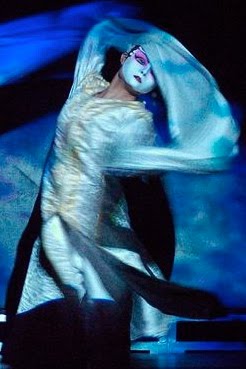
And then there's THE BLUE DRAGON, which has taken over the stage of the Royal Alexandra Theatre for a limited run, through Feb. 19, as part of the Mirvish subscription season.

Written in a collaboration between Marie Michaud, who is also a featured player, and the esteemed Robert Lepage, who directs, it is a story of deceptive simplicity, set in modern-day China — Shanghai and environs, to be specific. That's where 50-ish Pierre (played by Henri Chasse) has finally come to roost, fleeing artistic expectations and an unfocused marriage in Quebec, and carving out both a home and a career as a gallery owner from China's new openness.

But his life and his burgeoning romance with the lovely young artist, Xiao Ling (Tai Wei Foo), whom he has taken both under his wing and into his bed, is thrown into turmoil with the arrival of Claire (playwright Michaud), the wife he left behind. Now a successful career woman (and a bit of a lush), she has journeyed to China to fill a void she has found in her life by adopting a child. Slowly, the three lives intertwine, until they reach a surprise ending that really represents a world of possible new beginnings for each of them.
In short, it's a story that succeeds in holding one's interest, even while it stops short of being utterly compelling.

Or it would, that is, in lesser hands. But once it has been shaped by the finely honed theatrical vision of Lepage and his team, it becomes absolutely riveting, dazzling its audience with a rich blend of understated acting and a staging that is, as usual, utterly compelling in its mix of simple artistry and groundbreaking technology.

To cocoon this delicate story, designers Michel Gauthier (sets), Jeanne Lapierre (props), Jean-Sebastien Coté (sound), Louis-Xavier Gagnon-Lebrun (lighting), François St-Aubin (costumes) and David Leclerc (projections) conspire to transform, as if by magic, a simple two-level platform into everything from the interior of an airplane, to the skyline of Shanghai — with stops at galleries, restaurants, train stations, airports and sweatshops along the way.

They incorporate everything from Chinese calligraphy to dances of the cultural revolution into a story that unfolds seamlessly in three languages. And they do it with such an unstated ease that it rarely, if ever, impedes the flow of the storytelling. The set shifts and blends so perfectly, and so completely, with the action that the experience is transformed into a form of heightened cinema that is only slightly short of breathtaking, and never less than exhilarating.

But while the theatrical world that springs from Lepage's imagination proves, once again, to be a world of wonder, it also conspires to underline the fact that Lepage too often seems to limit his work to a technical canvas, choosing to leave the universe of big, theatrical emotions unexplored. This entry is, in fact, no exception. While THE BLUE DRAGON may breathe creative fire, it is a work that ultimately leaves its audience delighted and amazed but emotionally unruffled, still waiting for the story to catch fire emotionally.

Sunday, January 8, 2012


THEATRE REVIEW: NEXT STAGE, 2012

JOHN COULBOURN - QMI Agency
08 JAN 2012

TORONTO - If you want to know what would happen if they threw a theatre festival and nobody came, don’t ask the organizers of Toronto’s Next Stage Theatre Festival, currently underway at the Factory Theatre. In fact, since the organizers of the summer Fringe Festival decided, five years ago, to spread their wings in a January edition of the popular event, audiences have been braving the exigencies of winter weather in ever-increasing numbers, hungry to check out the annual line-up of promising, if frost-bitten, new works.

As usual, this year’s selection includes a few hits, a few strong efforts and the obligatory one or two that leave one wondering just how they made the cut. To help make your choices, here’s our run-down:

HYPNOGOGIC LOGIC: Great premise, charming performances and more than a few laughs in an off-the-wall, silly-buggers sort of style. In fact, the only thing missing in this offering from Montreal-based Uncalled For is a bit of judicious editing. It would still be lighter than air, of course, just as these things are supposed to be, but it would keep things firing on all cylinders all the time.

THE TIKI BIKINI BEACH PARADISE PARTY A-GO-GO: Okay, right off the top: A woody, in surf parlance, was a car, not a board, and sushi wasn’t big in the western world in the ’60s. But while playwright/director Allison Beula isn’t much on research, she does manage to keep things moving in this inconsequential send-up of ’60s surf movies, thanks to some slick choreography and fine tunes by Jeffery Straker, delivered with more enthusiasm than polish by a game cast.

LOVESEXMONEY: Hey, Kat Sandler. Last time I checked, it was 2012 and this was a Fringe Festival (of sorts) after all. So how come the play you wrote and directed — the one purporting to look at some of the more unconventional sexual hi-jinx of our age — comes across as a mash-up of bad British bedroom farce and ’60s sitcoms, inspired more by Neil Simon than Neil LaBute? Just asking.

LOVING THE STRANGER (or How To Recognize an Invert): Writer/director Alistair Newton builds both an unconventional history lesson and a cautionary tale around the life of artist Peter Flinsch, a gay man imprisoned by the Nazis during the Second World War for kissing another man. An homage to Berlin’s pre-war cabaret scene, it’s compelling, thought-provoking and often in-your-face funny — and Hume Baugh (as Flinsch) is the perfect anchor.

LIVING WITH HENRY: After scoring big in last year’s production of The Normal Heart — a play about people dying of AIDS — Ryan Kelly returns to the stage in a play about living with it, heading a hugely committed cast and bringing life and passion to an unflinching and promising new musical by Christopher Wilson, directed and choreographed by Donna Marie Baratta.

MODERN LOVE: Playwright/performer Jessica Moss takes a long, if not necessarily hard, look at love and the search for it in an age when we are so plugged in and turned on that we seem to have lost our ability to connect. And while she scores some telling, often funny points along the way, ultimately it all feels a little too self-referential, leaving one to suspect that it might benefit from a broadening of the cast list to include other characters and other viewpoints.

TOMASSO’S PARTY: Hopefully, the event that gives Jules Lewis’ play its title will prove more engaging than the play it’s inspired. Under the direction of Nigel Shaun Williams, a sleep-deprived couple, Simon Bracken and Leah Doz, anticipate the event in question and discover all sorts of things about themselves and their relationship. But while they may not be able to sleep, chances are their audience will, despite the best efforts of all involved.

THE WASHING MACHINE: Radha. S. Menon seems to have engineered a head-on collision between Tennessee Williams and Somerset Maugham in this little tale of tea and tedium in the post-Raj world — and sadly there are no survivors, despite the committed work from director Sasha Kovacs, designer Jung-Hye Kim and a cast whose commitment can’t be questioned. Talk about feeling like you’ve been put through the wringer.

The Next Stage Festival, which also includes two Ante-Chamber offerings — Love Is a Poverty You Can Sell and Morro & Jasp: Go Bake Yourself — continues at the Factory Theatre through Jan. 15. Visit fringetoronto.com for details.

Wednesday, January 4, 2012


MUSICAL THEATRE REVIEW: GREEN DAY'S AMERICAN IDIOT

JOHN COULBOURN - QMI Agency
04 JAN 2012
R: 3/5

Pictured: Jake Epstein, Scott J. Campbell, Van Hughes

In GREEN DAY'S AMERICAN IDIOT, Dancap's Aubrey Dan has managed to slip a belated but impressive Christmas package under the tree -- one almost certain to delight the younger demographic of the theatre-going public, in particular.

They are, after all, the ones most likely to be heading into the Toronto Centre for the Arts (where a touring production of the Tony Award-winning musical opened late last year) humming the tunes to the 2004 album of the same name -- to the extent that punk rock lends itself to humming, of course. But even if you've never heard Green Day's music and don't have much of a taste for rock musicals, this is an impressive production which never misses a beat as it brings an impressive array of theatrical magic to bear in telling the story of three disaffected slackers, at odds with the American way.

While the story revolves around Johnny (a compelling and charismatic Van Hughes, who is about to be replaced for a few shows by Canadian Gabriel Antonacci), it is wrapped up in the lives of buddies Will (our own Jake Epstein) and Tunny (Canuck Scott J. Campbell), as well.

At the outset, they are mired not only in small-town American ennui, but lost as well in the stupefying effects of late onset adolescence, it seems. In response, Will has taken root in front of the TV, Tunny has withdrawn into a taciturn world of slumber and inchoate rage and Johnny has become a serial self-abuser. Convinced that any place is more exciting than here and now, they decide to head to the city. Will, however, soon discovers his girlfriend (Leslie McDonel) is carrying his child, and opts to stay home, leaving Johnny and Tunny to carry on.

An all-but-catatonic Tunny soon joins the military for all the wrong reasons but Johnny simply drifts, eventually falling under the influence of St. Jimmy (a chilling Joshua Kobak as the spirit of heroin), at about the same time as he falls for Whatsername (Gabrielle McClinton). Sadly, the two don't mix. Tunny, meanwhile, heads off to war (presumably Desert Storm) and loses a leg and gains a girl (Nicci Claspell) before the shock of 9/11 brings them all back to where they started, scarred, but only slightly wiser.

Under the direction of Michael Mayer, this is a production that starts technically strong and never lets up -- a showcase, not merely for a hugely committed cast, but for the driving, almost confrontational, choreography of Steven Hoggett and the design acumen of Christine Jones (sets), Andrea Lauer (costumes), Kevin Adams (lighting), Brian Ronan (sound) and Darrel Maloney (video/projection), all powered by the musical supervision of Tom Kitt, which ties it all together.

All of which serves to underscore the real tragedy of AMERICAN IDIOT. For while this little bundle from Broadway is certainly an impressive Christmas present, it seems that the batteries are not included. Thanks to Green Day, it may possess the musical bonafides to make it memorable, but thanks to the sketchy book created by lyricist (and Green Day frontman) Billie Joe Armstrong and Michael Mayer, it fails to engage in any meaningful way. Despite deeply committed work from Hughes, Epstein and Campbell, there's simply not enough story and character development to drive the narrative, and while we may develop grudging affection for these three lily-white losers, ultimately we are forced to acknowledge that they are likely to remain losers.

While the easily distracted are almost certain to be taken in by AMERICAN IDIOT's flash, most thinking theatre-goers, one suspects, will likely realize that, while a story about the disconnected that leaves us feeling disconnected might make for a fine punk musical, a musical about apathy that leaves us feeling apathetic is simply not great theatre -- in any genre.

SPOTLIGHT on PHILIP AKIN,
Performing Artist of the Year

JOHN COULBOURN - QMI Agency
28 DEC/11

TORONTO - When Philip Akin became the first Canadian-born black man to hit the Stratford stage in the title role of Shakespeare's Othello back in  2007 — and subsequently pulled it off with enviable panache — we began to suspect that here was a theatre artist with whom to conjure.


But it wasn't until Akin assumed the mantle of artistic director of Obsidian Theatre that we really got a chance to take the measure of the man. Akin is an artist who made his name as an actor, but seems destined to achieve greatness as a director. 
Indeed, he has come awfully close in 2011.


First, he swept his audience up and carried them away to a brothel in the middle of the war-ravaged Republic of Congo, unearthing love and compassion among the Ruined as he brought life to Lynn Nottage's Pulitzer Prize-winning play.
 Then, he moved his focus to the Shaw Festival, where his production of Topdog/Underdog, a compelling work for two actors written by Suzan-Lori Parks, proved to be one of the highlights of the season, despite the fact that it was programmed into the Festival's smallest space.

With Nigel Shawn Williams and Kevin Hanchard, Akin created a riveting production of familial trust and betrayal that proved as compelling to a Toronto audience in a subsequent Theatre Centre revival as it did to the audience in the Shaw's Studio space.


Taken individually, each of these shows represented impressive work from a journeyman director, but collectively, no matter how you do the math, they add up to our performing artist of the year.

THEATRE NEWS: BEST ON STAGE, 2011

JOHN COULBOURN - QMI Agency
28 DEC/11

Before we pack away the tinsel and get on with the business of filling up a whole new calendar, let's savour the things that decked our theatrical hall and made this a year to remember. Herewith, in no particular order, are productions that caught my eye, my heart and my imagination over the past year. Hopefully, one or two of them touched yours as well:

1. The Last 15 Seconds: Kitchener-Waterloo's MT Space's compelling piece of movement theatre, about a suicide bomber and the man he killed, exploded on the Theatre Passe Muraille stage and was gone before most people realized it was there. Pity, both for a hugely talented company and for those who missed them.

2. TopDog/Underdog: Nigel Shaun Williams and Kevin Hanchard teamed up with director Philip Akin to make Suzan-Lori Parks' compelling yarn of two black brothers one of the most riveting productions of the Shaw Festival's 60th anniversary season, remounted with equal power at the Theatre Centre.

3. Tout comme elle (Just Like Her): Theatre offerings at Luminato have been a little hit 'n' miss — and with 50 of our finest actresses on stage, under the direction of Brigette Haentjens, Louise Dupré's play (translated by Erin Moore) was definitely one of the hits.

4. Ruined: Obsidian's Philip Akin and playwright Lynn Nottage proved an explosive combination once again in this Pulitzer Prize-winning play set in the heart of the war-torn Congo, featuring a superb cast, headed by the always-memorable Yanna McIntosh.

5. Cat On A Hot Tin Roof: After Stratford's 2005 production, some thought Tennessee Williams' most enduring drama might have reached its best-before date. But with Eda Homes at the helm, the Shaw proved there's plenty of life left in it, thanks to performers such as Moya O'Connell, Gray Powell, Jim Mezon and Corrine Koslo.

6. The Normal Heart: Larry Kramer's look at the early days of the AIDS epidemic has lost none of its power in the almost 30 years since it was written — and if Studio 180's Joel Greenberg came up a little short on Kramer's monumental rage in his production, it still packed a wallop and gave us a look at what history might judge to be the birth of a gay nation.

7. Orfeo ed Euridice/Iphigenia in Tauris: When it comes to truly fine opera productions, the Canadian Opera Company proved it was all Greek to them. In the end, trying to say which of Glück's masterworks showcased the talents of director Robert Carson to best advantage was just too hard — so you decide.

8. Jesus Christ Superstar: Some questioned Des McAnuff's decision to program this Andrew Lloyd Webber/Tim Rice artifact at the Stratford Festival — until they saw the crackerjack production he put together. Currently Broadway-bound by way of the LaJolla Playhouse, it's earning a chorus of Hallelujahs there.

9. Alice's Adventures In Wonderland: The National Ballet of Canada teamed up with Britain's Royal Ballet and choreographer Christopher Wheeldon and ended up packing a whole lot of modern-day wonder in Lewis Carroll's classic tale.

10. Red: A few critics sneered at the "middle-brow" level discourse in John Logan's Tony Award-winning script about painter Mark Rothko — but when Canadian Stage teams up actors such as Jim Mezon and David Coomber, under the direction of Kim Collier, middle-brow is just another word for brilliant.

Deluxe in the Redux: Still great the second time around: 2 Pianos 4 Hands, Onegin, The Shape Of A Girl, Assassins, The President